|
.
.
.
.
Spiral
Dynamics®
and the E-C
Theory of Dr. Clare W. Graves
.
.
Online notes provided by Chris Cowan and Natasha Todorovic, NVC Consulting. Click
for training schedule
See
topics tab and the books Clare
W. Graves: Levels of Psychological Existence, The
Never Ending Quest, and
Spiral Dynamics
for further information and references for the theory.
.
Comments and
opinions are occasionally updated with new additions at the
bottom of the list.
..
....
What
is Spiral Dynamics®?
Is
Spiral Dynamics about waves or particles?
Where
did the colors in Spiral Dynamics* come from?
Are
the colors linked to the chakras or any other pattern?
What
do the pairs of letters (A-N, B-O, C-P, etc.) mean and how do they
relate to the colors?
Why
are there only eight systems?
How
do the vMemes in Spiral Dynamics and memetics and Dr.
Graves's work connect?
Is
Spiral Dynamics a typology?
Is
this model hierarchical?
Is
there a timeline for systems emergence?
What's
the highest level, Coral?
What
do the terms "First Tier" and "Second Tier"
signify?
Do
people move up from one level to the next like climbing stairs?
How
does intelligence relate to this theory?
What
about emotions and temperament factors?
What
is "the Prime Directive?"
Did
Dr. Graves come up with the name, "Spiral Dynamics?"
How
do I learn more about Dr. Graves's original work?
Are
there assessments available?
Are
there other people applying this model?
Who
can understand and apply this theory?
Why
don't the numbers in the table on pp. 300-301 of Spiral Dynamics
add up to 100%?
How
do memes and vMemes relate to thema and schema?
What
about the Third Tier (Double Prime) Levels - A''N'', B''O'', etc.?
Is
"Flatland" a construct from SD or Graves?
Does SD/Graves apply to large groups and not to
individuals?
Is
terrorism "Red?'
Is
there such a thing as "the Mean Green meme?"
What
about SD and "consciousness?"
Is
Spiral Dynamics a religion, or a cult?
What
is 'the design question?'
Any
opinions on SD as related to politics? Why
do some people talk about 'integral' with SD while we don't?
What
does ‘emergent’ mean in context of Graves/SD?
How
does SD relate to Abraham Maslow's work through Graves? (see Oct/Nov
2005 newsletter)
How
do the 6 Conditions for Change and the Change States relate?
Does
gender play a role in SD and Gravesian systems?
Got
a question that's not here, yet?
What
is Spiral Dynamics®?
Spiral Dynamics (SD) is a way of looking at different ways people
think and then building systems which better match who we are and who
we are
likely to become, as individuals, organizations, and even societies.
It is applicable in personal growth and coaching, organization
development and leadership training, strategy and culture studies,
social transformation, and many other domains and scales. Also called
Levels of Existence theory, this point of view rooted in the
psychology of human development seeks to differentiate
how people think and value, then to connect them better with
organization forms, educational methods, leadership models, governance
approaches, and
motivational packages which are congruent with who they are and will
be.
SD is both a simplification and popular application of Dr. Clare W. Graves's
remarkable 'emergent
cyclical double-helix model of adult biopsychosocial systems development -
'Levels of Existence Theory' (EC) for short. SD is useful, therefore,
because it forms a bridge across lines separating disciplines and knowledge sets to
connect many ways of knowing and for exploring the 'dark matter' of
the brain. It is both broadly accessible and eminently practical with
just a bit of effort. (For a brief introduction and overview, click
here)
The work is rooted in systems
theory and developmental psychology, and concentrates on the quest to
describe the mature
adult personality (audio)
in operation with all its permutations, manifestations, positive and
negative traits. Graves's very descriptive label,
"biopsychosocial systems," suggests the imperative to
integrate the bio- (biology, genetics, neurosciences) with the psychological factors and
the sociocultural forces acting on people, all within a General
Systems-oriented view. One reason good
intentions often collapse in failure is that all these elements are not incorporated into the
solutions and addressed simultaneously, a gap now beginning to close
in the study of the mind and brain.
SD is a map to the nature of human natures drawn atop Graves's
foundation. Thus, it has been called a "psychological
map." It is also point
of view and a way of thinking which provides a way to chart
differences in leadership, learning, management, social structures,
economics, and virtually every other area where human thinking has an
impact. That's saying a lot because the perspective offers a broad view of
who we are and who we might become as Homo sapiens moves
through psychosocial space.
The
"Spiral" part depicts how people develop diverse worldviews
and the characteristics of those; it is a metaphor for the
double-helix form used by the scholar on whose work SD is based, Dr.
Clare Graves. It represents the building of new systems upon
previous states through the interaction of the world outside with
neurology inside while shifting focus between the inner self and the
world outside. The "Dynamics" side explores the
process of emergence and how living systems evolve, grow, and change.
In this view, neither maturity nor human nature is fixed nor
predetermined. SD is thus concerned with why we cooperate, collaborate, and conflict over
differences in values and in the underlying Value Systems that shape them. It
concentrates on human thinking systems - deep valuing structures - instead of the contents - the
surface attitudes, values, and beliefs - which occupy them.
Those who really understand
this model - and that's not all the people who claim expertise since
urban legends about this work abound -
recognize that it is not a typology, a stairway to godliness, a
religion, a weapon, a cult, a panacea, a way of life, a hierarchy of intellectual
capital, or a pedestal from which elitists can look down on the rest
of us. Instead, it's a theory of how people frame the reality they
experience; i.e., how people sense their worlds and build mental
models, why they choose to do what they
do from a set of distinct 'logics,'
and what we can do because of that diversity of systems to deal with
each other better. It seeks compassion and
integration without dismissing differentiation, recognizing both
strengths and weaknesses throughout. One thing we've discovered is
that saying such things is sometimes framed as blasphemy and heresy by
those devoted to the quest for true beliefs and gurus to lead them to
salvation. (See the .pdf SD
mini-course or the Spanish version,
as well as the online
brochure.)
We (Cowan & Todorovic) are sometimes characterized as the Gravesian 'purists' because we
insist on accuracy when talking about what Dr.
Graves wrote and said. For some people, that's a pejorative and they use
'purist' as a put-down to suggest stuck in the past and unwilling to
bend, as if we, too, are guru worshippers. With that we strongly
disagree and propose its simply good and responsible scholarship. We
fully recognize that Graves is only one contributor among many who
have built our understanding of human nature. He makes that abundantly
clear in his own work, the Never Ending Quest. But just as it
is important to understand what James, Freud, Jung, Watson, Horney,
Erikson, Piaget, or any of the other greats proposed before claiming
expertise and then spinning off from it, we suggest that there is a
lot in Gravesian theory which needs to recognized and tested before
positioning one's self as a Gravesian authority. Because we're
convinced his work is a significant contribution, we believe that
people should know Graves's work first-hand and pretty well before
either revering or dismissing it.
Our aim here is to build a solid base with
Graves and then to promote verification, expansion and further
refinement of the point of view - to test it and see what's next in
conjunction with many sources of knowing that reach far beyond his
ground-breaking work. We would not provide as much information here,
in our publications, and on our www.clarewgraves.com
website if it were otherwise. Yet as we say, Graves is but one contributor to the
evolution of psychological understanding. Our
purism comes from an insistence that growth in this theory, when
flying its flag, be from a solid and
accurate footing and not one build on rumors, conjecture, or
assumptions rooted more in projections, marketing, simplistic
politics, and wishful thinking than
rigorous investigation. If the work proves to be full of holes and the theory
doesn't work, let's prove it. Clare Graves often said he was climbing
out onto a fragile limb as he dropped this seed. On the other hand, if it does offer
explanatory power and
stands up, then let's build on that with integrity and precision
instead of wild guesses and hype. In either case,
having a common footing and agreed starting place is the best way to
do that. So, perhaps, purists we be if that means respecting the work
and then seeking to investigate it further.
The SD application of Graves is conceptually rich, and many other useful theories, models,
knowledge sets, and techniques can be sorted through its lens to
better match therapists with clients, teachers and students, managers
and employees, governance and governed, investigators with topics.
Likewise, SD can be adopted to complement other ways of knowing,
ranging from strategic approaches to personal growth. By
using SD tools, business people can understand organizational culture
with more finesse. Coaches can better work with clients in transition
and maximize those at stability. Educators can design learning which
makes better sense with more relevance to learners. Parents and their
children can begin to recognize each others' needs and viewpoints.
Managers can address human factors dilemmas because SD describes them
in a language that reaches far beyond the usual demographics.
Marketers can improve communications, and health care can reach
patients more effectively. Religious leaders can tailor their efforts
to serve a range of groups simultaneously, and the average person can
find comfort in what sometimes feels like an incomprehensible world.
Why? Because SD grants human beings the right to be who they are, a
window to see how they might be, and a map to find where others are.
SD is a way of thinking and making connections which, while not new or
revolutionary in many respects, cumulatively gives more explanatory power than practically anything
else by providing a means to pull lots of information and insight
together and then to focus it. SD is not merely a color code of categories
(see below) or a set of labels for behavior. It is, instead, a complex and, we believe, highly
enriching way of thinking about things if the principles are
understood and applied - a way of exploring human nature. It is not, however, a way of life, a path to
follow toward enlightenment, or a club whose adherents conform to some
set of standards or beliefs. It is a theory about how the human being
emerges, stabilizes, and changes as an individual, an organization,
and a species; all sorts of people find it
interesting and of use and it can be accessed by almost anyone though
the theory predicts that not everyone will grasp the whole of it.
Lastly, Spiral Dynamics® is a registered trademark of the
National Values Center, Inc., and protected by
international treaty; it is the title of the 1996 book which laid the
groundwork for this (Spiral Dynamics: Mastering Values, Leadership,
and Change, Blackwell Publishers); a brand for an application of Gravesian theory which
has certain protections under law and decency; and a body of intellectual property
(IP) including quite a lot of copyrighted and proprietary materials which
we are obliged to protect to the best of our ability. Duplicating
those items or copying pages from this site and reproducing them without
authorization,
and especially if copyright and authorship are removed or replaced
with someone else's for use on their websites or handouts in courses, is reprehensible. Just because something is made
available for public viewing does not mean it is in the public
domain.
Many people fly
the SD flag these days, some honorably and some not. We simply ask that they recognize the
source;
acknowledge all the owners and creators, not just their personal
gurus; and abide by
the normal conventions of trademark, copyrights, and permissions to
reproduce materials since to do
otherwise is a violation of both ethics and international law.
Is Spiral
Dynamics® about waves or particles?
Both. There are two ways to approach this theory. One views the
emergent systems like overlapping waves that roll across the shifting
sands of human nature - waves arrive in a series. Each comes in gradually, breaks mightily, and
then folds back to become part of the next surge. There is overlap,
mixing, and interaction with as much emphasis given to reading the
transitions as riding the peaks of the curves. The foaming waters of
new thinking cause our world to be different; we become different and
change our world.. In this view, the transitional states are apparent
in the waves as they rise and fall. Graphics appropriate to this
framing show overlapping curves, blended stacks, and multi-layered
sequences as the point of centralization slides among a hierarchy of
systems in a sequential flow. There is a certain fuzziness to this
approach which is discomforting to those who demand precision, and
which is reassuring to those who are uncomfortable with absolutes and
categories. It does suggest a sequence, however, which is
discomforting to those with a distaste for hierarchy.
The other approach treats Graves's levels of psychological existence (or
SD's vMemes) more like discrete particles with lives -
almost consciousness - of their own. They all potentially exist at the
same time. Closer to the memeticists' view
of how ideas migrate, in this view the systems exist as
quasi-independent entities which arrive and depart from human
awareness as conditions change. (One reason quantum physics language
is popular in discussing SD.) One can speak of the arrival of a vMeme,
their brightenings and dimmings, and even how they can compete for
prominence on the mindscape. In this approach, the vMeme is
the focus with the person functioning more like a host. The idea of
tracking vMeme migrations and monitoring their emergence
fits this school. Graphics typical of this framing involve stacks of
blobs, proportional onions, and even stair steps. Whereas the
wave-like view is more of an emergent process with a prescribed
hierarchy for the arriving waves but without guarantees of timing or
details, this viewpoint allows discussions to
center around proportions of vMemes, various combinations
that disregard the sequence, and even talk of "skipping" a
level to take short-cuts. (We disagree with much of this because it simply doesn't reflect Graves/SD
theory which, like it or not, does describe a hierarchy of
increasingly complex systems.)
This dualistic nature of the model is sometimes confusing; yet it
needn't be unless one takes either view as an extreme position. Much
of Dr. Graves own original writing was more particle-like because it
is far easier to be descriptive and concise when speaking of levels
(and sub-levels) one-at-a-time. Indeed, most of the theories to which
he compared his work involved stages and developmental sequences. That
sometimes leads to such categorical language as: "4's do
thus...," "an Orange would...," or "if an F-S
personality were in charge, it would...", though phrases like
"a person centralized in her E-R would tend to..." and
"when the person is moving from C-P toward D-Q..." are more
apt.
Yet many of his graphics were efforts to depict the wave-like nature
of human nature and how these "ways of thinking about a
thing" do not represent all-encompassing typologies for people,
but describe the level of thinking regards a given aspect of living as
it relates to other aspects. Had computer graphics been available in
his day, no doubt his illustrations would have been 3-D or holograms.
The Spiral Dynamics book leans toward the particle view in some
places, toward the wave-like in others. Readers/users simply need to
be comfortable with both and recognize that they do, in fact, overlap.
Where
did the colors in Spiral Dynamics® come from?
1
BEIGE (A-N)
2 PURPLE (B-O)
3 RED (C-P)
4 BLUE (D-Q)
5 ORANGE (E-R)
6 GREEN (F-S)
7
YELLOW (G-T)
8 TURQUOISE (H-U)
First
of all, Dr. Clare W. Graves (upon whose work Spiral Dynamics is based
- see our www.clarewgraves.com
website for some original papers and books)
didn't use the colors. Instead, Graves generally relied on his original letter-pairs, as well as numbers and names on occasion. The color scheme was applied to Dr. Graves's levels
of existence in the 1970's by Chris Cowan for making title slides for
use in teaching the theory. The particular color choices were made as a design element
to make harsh black-and-white graphics more attractive and took about
15 minutes one afternoon - nothing esoteric, metaphysical, or
inspirational about the process. It was as much for
ease in sorting training materials as anything else, then turned into a
common language when included as part of the publication of the Spiral
Dynamics book by Beck and Cowan in 1996 because the letters
seemed too complicated for the intended audience for that book which
was expected to be more business-oriented. While there was a
loose metaphor behind the color choices, there was certainly no metaphysical significance
intended, nor was it derived from chakras or anything else (see
below). The ordering was deliberately picked to differ from the
visible light spectrum, though we've received complaints now and then
from literal-minded folks asking if we can't recognize a rainbow when we
see one, and why we don't revise the color scheme to 'fit' nature
better.
The color code has taken on a life of its own, sometimes to
the detriment of the model since it makes discussion of the transition
states almost impossible. While one can now specify Windows colors in
hexadecimal notation to represent subtler shades, that's going a bit
far. The Gravesian letter pairs - admittedly somewhat tedious to learn
at the outset - offer far more power with differentiations like CP/dq
versus DQ/cp possible. Those who fall into the trap of
"color-speak" jargon and then use it like a judgmental paint ball
gun to attack or compliment foes and friends simply do not understand
the theory very well. While it has become a lingua franca for some
spin-off movements and spread widely by some unscrupulous knock-off
artists who sell typology, we do not put much store in the colors and
continue to emphasize with the letter-pair terminology
which is closer to Gravesian roots
than the pop-spirituality derivatives which prefer the chromatic
labels. Click here for more
details.
We are coming close to relegating the colors to describing
stereotypical sets of values and behaviors and using the letter-pairs
to describe the levels of existence within which they arise. Many of
the growing number of SD fans fail to grasp (and have not been taught)
the difference between content and process (see thema
and schema). Thus, a good test of SD expertise is to listen for
the person to differentiate between exploring how people come to
assign value and describing what they value. Most can do the latter.
Few concentrate on the former, and that is where the theory
lives.
Are
the colors linked to the chakras or any other spectral pattern?
No,
only by coincidence. Nor is there a connection with color therapy or
the seven rays of esoteric psychology. (Click
here for a tongue-in-cheek narration of how the color code came
about.) We wish we could claim some kind of mystical inspiration for
the choices, but they were merely obvious metaphors
suggesting aspects of the levels they represent. No colors have been assigned for nodal systems
beyond Turquoise and Coral, though Teal and Aubergine are candidates,
and Azure and Plum have a certain appeal, too. Recently, 'white' has
become a candidate for the final, end state which, of course, does not
exist within the Gravesian perspective even though it's the dream of
many of the transpersonal and neo-spiritual set.
Mix the colors of light
and the result is white. (Mix dogs and they come out brown.) Thus appears a
presupposition that 'white' must be some kind of transcendental,
godlike state
of whatever, just as the 'eventual' dog of dogs would be a brown mutt.
That's tied to one of the misinterpretations of A'N'
(Yellow) - that it's just a blending of all the systems and suddenly
all things come clear once it's awakened. This is also part of the
un-Gravesian notion of a finish and the need for a penultimate end
state rather than a series of ongoing next levels. This if often a
point of confusion when Graves's seventh level is equated with Abraham
Maslow's 'self-acutalized' man. While Maslow was in search of a
complete being who could capture peak experience and find an ultimate
fulfillment only a step or so ahead, the Gravesian theory posits the
need for completeness in a religious sense as characteristic of fourth
level man who looks for salvation, and in the less religion-bounded
quest for transcendence as a liberated being as a phenomenon of the
fifth level in transition to the sixth. Because this point of view is
open-ended, self-actualization is only another in the series of steps,
the final destination of which is unknown and unknowable. (See Oct/Nov
newsletter .pdf for more)
The colors are only a metaphor and symbolic code to make conversation
easier. They were introduced for graphics to make training
materials more attractive and have very limited relationship to
Dr. Graves's work; he only used them in a few joint seminars as a
courtesy (because slides onscreen were tinted) and
stuck, for the most part, with the letter pair language.
If the cyclical
pattern in the theory holds, then future color choices will require the alternation
between the cool and warm families with swinging emphasis between the
collective and the individual, a tendency to deny (sacrifice) self in
favor of the group over to express self and self-interest apart from
the group, i.e., the 'sacrificial' and 'expressive' systems. (Graves hypothesized this might also
relate to brain hemisphere dominance. See NEQ.) The cool colors
represent a
more externalized locus of control (reinforcement generally expected from
something outside of and beyond control of the self) with an
inward-looking focus on coming to peace with self, others, and the
universe - sacrificialness; the warm colors would have more of an internal locus
of control (reinforcement resulting from
own efforts and decisions within the self) and a concurrent focus outward to mastery and
control of the external world - expressiveness. As that distinction softens,
so might the tones since none of these distinctions are hard-edged. (See Julian Rotter's Social Learning Theory for
more on locus of control.)
Some people try to relate colors to consciousness and to create a
spectrum in the visible light range as either a metaphor or a literal
reflection of mind. (Frequency and consciousness are likely to be
related, and frequency-speak has been popular for decades since the
universe and our being ride on the electromagnetic spectrum.) While such pursuits
in the visible range are interesting and
entertaining as art, metaphor, and poetry, we remain skeptical that a particular wavelength
in nanometers or a certain frequency in Hertz (single to tera- or
greater) has much more to do with a mindscape than a set of
letters or a number - or a dog. Perhaps energies of different
frequencies do have an effect on the brain, as illustrated with the
color temperature and frequency of ambient lighting as a mood setter
in restaurants - dining or fast food? And perhaps the brain/mind
complex vibrates in some very curious ways we don't yet understand in
the realm of spirit. (See
the work of Valerie Hunt and many others.) But trying to tie that to
what the retina can perceive and then equating that with Gravesian
levels strikes us, at this point, as rather
silly and giving far more power to a rather primitive eye which still produces an
upside-down image that the brain must sort out than is its due. Thus,
our attention to the assorted rainbow warriors out to prove that the
paint chips of consciousness carry huge meaning and significance is
limited, though any good science (not channeling or conjecture) would
be welcome. Who knows for sure: perhaps 470nm really is the wavelength of DQ, and the
frequency of A'N' is 510THz, and Greens at 500nm are different
characters from those at 570; but we very seriously doubt it.
What
do the pairs of letters (A-N, B-O, C-P, etc.) mean and how do they
relate to the colors?
The
letter pairs were Dr. Graves's original terminology; colors
were added for Spiral Dynamics. His double-helix
notion included Conditions for Existence in the milieu (the Life
Conditions in Spiral Dynamics) as the first letter - A, B, C, D, E, F,
G (or A'), H (or B'), etc., and the neurobiological equipment in the
brain - N, O, P, Q, R, S,
T (or N'), U (or O'), etc.- that turns on to produce the Coping Systems.
(Click here
to view a chart describing the relationships.) Each Coping System or 'level of
psychological existence' is the interaction product of those elements
- the world outside with the neuronal systems inside -
thus
A-N,
B-O,
C-P,
D-Q,
E-R, and
F-S
(plus either a continuation -
G-T,
H-U,
etc., or primes like
A'-N',
B'O'), describe them. The letter pair language
is far superior to the colors because it conveys the interaction of
the problems of existence outside with the mind/brain system within.
Although Dr. Graves used numbers 1 through 8 on occasion, he relied
primarily on the letter pairs. We teach this as the primary label set
in certification courses, followed by colors as a short-hand, since
the alphabet labels permit discussion of the critical entering and
exiting transition states - a-n/B-O, B-O/c-p, b-o/C-P, etc. Of
particular interest right now in the world are the D-Q/e-r, d-q/E-R,
E-R/f-s, and e-r/F-S zones. See the discussion of tiers
(below) and transitions for more.
This idea of two interacting forces is actually central to Gravesian
theory and the foundation of SD. The use of letter pairs (rather
than colors or numbers) serves to emphasize this double-helix notion
that sets this model apart from many others which simply rely on
typologies and traits. We always use the letter pair language in more advanced trainings since it
reminds the student of the work to consider
both of the double-helix variables - life conditions (existential
problems) in the milieu and coping means (neuronal systems) within the
organism. That is to say that both genetic
predisposition and neuronal systems and experiences accrued in
living and learning contribute to shape who we are. Effective
change engages both aspects, not just one of them. This interplay is
frequently overlooked when the model is turned into typology, and that
dilutes the worth of it considerably.
The alignment of A with N, B with O, etc., produces the nodal states
(Levels of Existence) represented with the colors. (The letter pairs
were originally derived from simply dividing the alphabet into two
halves: A to M for
Helix I and N to Z for Helix II; thus, A pairs with N, B with O, etc.
In his later work when Graves was considering a 6 upon 6 pattern from
which the tier notion is derived, the
need for letters fell to only twelve with the inclusion of primes for
repeating levels -
A-N, A'-N', A''-N'', etc.)
When the helix letters are 'normally' aligned as above, the interaction
produces stability in the the vMemes or coping systems
described in Graves and SD: C-P, D-Q, E-R, etc. However, there can be
'slippage' as either the problems out-strip the thinking capacities
awakened thus far (E with P or Q, for example), or the thinking
expands and stretches beyond the demands of the situation (S or N'
with D). In the first case the thinking is no match for the problems
which increase; in the latter, the thinking is well beyond the demands
of the problems which produces boredom in the human.
Generally, according to Graves, the problems lead the solutions; thus,
the demands imposed by Helix I issues (generated by successful living
at a level) stretch the thinking and cause more brain capacity to turn
on to deal with them, either individually or collectively. However, it
is also possible that the neurology can shift, thereby altering the
perceptual field and the view of the externals; so it is the junction,
rather than the sequence, which energizes the state. It is at
this inflection point where the releasor/change
conditions become relevant. In some cases, a disparity leads to
constructive change toward a new congruent state with greater capacity
brought in play. In others, it triggers misery and serious problems because
the potential is not accessible or the barriers seem too profound
despite insight into what could be.
When the neurology surges
ahead of the existential field - the thinking is way ahead of the
problems at hand - people are sometimes considered odd, outliers,
prophets or heretics. Because of this shift in Helix II before changes
in Helix I are widely recognized, many people today -
especially young people - are very frustrated in both their jobs and
when observing the political landscape when they recognize that their
thinking is far beyond that of both their bosses, teachers, and political
leaders. Sometimes this frustration is due to a falsely inflated
sense of own capacities (common for C-P and E-R), and sometimes the
cognitive capacity is simply far outside and ahead of the box.
This interplay between the double-helix forces represented by the
letters is one of the more
powerful aspects of this model, and understanding the dynamics -
conditions outside with systems inside - a key element in the theory. While there is a great deal to be done in the
study in each of them, the energy of the convergence is also an area
deserving considerable more investigation and rigorous research.
Why
are there only eight systems (colors)?
There are not just 8 systems, though there are only 8 decorative colors in the
commonly used decorative palette. Actually, Dr. Graves's model is an open-ended theory with an
unlimited number of systems ahead (thus the need for a spectrum rather
than blobs). His original research picked up 8 nodal
states which are like the peaks of overlapping curves, and we see
little evidence of anything else thus far as evidence of a ninth
(though lots of conjecture and wishful thinking about one). Between these
Nodal points, represented by the 8 common colors, are Entering
and Exiting sub-states where most of the energy lies. That's a basic
trap of using the 8-band color code which those who are well trained in the
theory avoid. Thus, there are at least 21 distinct stages in
the emergent, cyclical model as it has developed thus far (entering,
nodal, and exiting for each).
For many years, only seven levels sufficed to
introduce the theory; we are not convinced that is still not so. While Graves found evidence of it, his data were
scant and B'-O' / 8 / Turquoise has only recently been included
widely. The eighth is emerging, though good research on its nature is
still yet to be conducted. If the theory holds, then ninth, tenth,
eleventh, and many more Levels of Psychological Existence lie ahead in
the human repertoire. However, in our opinion, any attempts to
describe them at this point are pure conjecture and, more often than
not, based in extrapolations from D-Q religion, E-R self-empowerment
and stretched individualism,
and F-S neo-spirituality rooted in hopeful projections. The requisite existential problems needed to
activate the more elaborated mind/brain systems have not appeared with
sufficient clarity or urgency to produce widespread A'N', much less
B'O', and
efforts to fuse philosophical and metaphysical hierarchies into the
Gravesian perspective miss the point of the levels of psychological
existence theory. Yet these and more systems there surely will
be. Click
here for more details.
How
do the vMemes in Spiral Dynamics®, memetics, and Dr.
Graves's work connect?
First,
Dr. Graves didn't speak of memes or memetics, nor of vMemes
or colors. That terminology was all added with the Spiral Dynamics application in the
1990's, and Gravesian theory does quite fine without any of it.
Unfortunately, memes and vMemes are now confused by people
who should know better yet either refuse or incapable of recognizing the
distinctions between systems and their ingredients. It's important for
those serious about this work to understand the difference since each
can contribute to the other, but to conflate them is to diminish
both. Graves spoke of 'levels of psychological existence' -
a.ka.LOE. Use of this term rather than vMeme can eliminate
the confusion with memes. Thus, Gravesian systems are LOEs, memes are
memes.
Many of the
findings of the memeticists help to explain how the
ideas carried in ways of thinking
in Spiral Dynamics migrate and spread among minds like viruses. At the same time,
Spiral Dynamics provides a framework for analysis of memes and an
understanding of why some attach to some minds, at some times, and not
to others. Thus, memes are idea contents and vMemes the
containers in our minds in which they fit. The two interact, and they
are not the same thing. (See thema and schema,
below)
vMeme
was coined with the writing of Spiral Dynamics to represent a
Gravesian 'level of psychological existence' or coping system, a term
we frequently use instead. In that book, they are described as meme
attractors and a sort of meme-maker that anchors a coping or value
system. The typography was built to suggest a value system-based (v)
meme field (vMeme) and to distinguish it from the more
specific "memes" it might attract and which might bond
congruently to it.
While some people, incredibly, still insist on confusing the terms as
if they were synonyms,
the two constructs are very different. This conflation builds
semantic confusion and suggests all the terms refer to the same thing,
an overlap which promotes imprecision and glib stereotypes. The meme is an
idea chunk, a thought, an image. The vMeme a complex
biopsychosocial system for conceptualizing existence - a tool for
thinking about memes.
To add to the confusion, the color-code for SD
levels - Green
or Orange, for
example - has taken on a memetic life of its own and spread. These
eight colors, as packets of meaning, have become memes, memes which
serve as surrogates for partial and often biased
and inaccurate descriptions of vMemes. The color adjectives
have become nouns for too many exploiters of this work who fail to
differentiate exemplar memes - attractees - from the far more abstract
and open vMemes - the attractors. Behaviors and beliefs are
being identified as levels of existence, outcomes overlap their own
causes. Now, even the relatively insignificant colors are being
challenged and tweaked, a further step toward confusion rather than
clarity.
Recent works by
Susan
Blackmore, one of the early authorities in memetics, and
others formerly in the field of memetics, discuss consciousness and
its variations. Some of this exploration
moves closer to
the Graves/Spiral Dynamics sense of a biopsychosocial energy field and
framework for sensing and conceptualizing reality - how memes are
handled in the mind. But for Blackmore and others, the original
Dawkins notion of a virus-like meme as a self-replicating idea packet
remains quite clear and useful, and a simplistic conflating of memes
with vMemes (or whatever one might call Graves's levels) is
befuddling and counterproductive. While the two things relate, they
are not the same. We continue to argue that both constructs - memes and vMemes -
are useful bits for analysis and that, as described in the 1996 Spiral
Dynamics book, vMemes are like attractors and
containers, and memes like floating ideas. (Click here for
more on memes and vMemes)
Is
Spiral Dynamics® a typology?
Dr.
Graves's theory is of an emergent process, not a set of categories or
boxes for people, nor a series of essential developmental stages
locked into chronology.
These are systems within the person or group, not kinds of
persons or groups. They are ways of thinking about a thing, not labels
for thinkers. In theory, the potential for all of these systems
lies within everyone with a normal brain, and that's the vast majority
of people. However, all the systems aren't awakened because the theory
is a process of interaction between the neurobiology of the person (or
group) with existential problems and conditions in the external
milieu.
In some of Dr. Graves's writing, he speaks of centralization with the
idea that a personality can localize somewhere along the hierarchy of
levels of psychological existence. It is this centralization which
permits people to speak of "4s" or "Blues" and get
some meaning across. However, reality is not so simple unless
closedness is in play. Centralization is topical such that a person
might be mostly localized, but think quite differently about
another thing. And in some cases, the person might have multiple zones
of centralization. It's that view which leads to the idea of vMemes
expressed in Spiral Dynamics and the notion that they occupy a mind as
much as the mind occupies a place on the spiral - clusters of systems,
stacks, and complex profiles.
Don't ask, "How do you deal with this kind of
person?" Instead, seek to understand how to manage the form of
thinking and behavior as it is being exhibited by the person,
regarding a particular thing, at this time, under these conditions.
Thus, the informed SD user asks "How do I manage the Orange (E-R) in this person?"
instead of "How do you deal with Orange people?"
For more, see Waves or Particles above, or click here.
Is
this model hierarchical?
Yes, in several ways.
Built into the theory are the notions of movement, expansion, and
increase in conceptual space. Each new system subsumes the ones that
came before, carrying forward elements of the past and putting a new
face and new mind at the forefront. However, it is not a hierarchy in
terms of most intelligences, or temperament, or many other dimensions which
ebb and flow throughout the Spiral. Thus, it is both hierarchical to
the extent that there is an additive sequence of problems and
solutions and it is about hierarchy, suggesting that
hierarchy-attenuating and hierarchy-enhancing systems alternate
throughout.
The awakening of each system opens
the opportunity for inclusion of more elements, but does not guarantee
it. Click here for a .pdf
version of Dr. Graves addressing this point. Although Graves
frequently spoke of vertical directionality - 'up' to 'higher' levels
- there's no reason whatsoever that the model can't as easily go
sideways, downward, or layer like an onion. Indeed, he made it clear
that appropriateness - "either higher or lower in the
hierarchy" - is the key. The preference for
verticality is more a cultural leaning than a theoretical factor,
however, and the model may be seen as lateral movement or even
increasing volume.
Hierarchy is part of Homo sapiens. How that characteristic is
expressed varies among the Gravesian levels. This relates to the cyclic
aspect of the theory as individual-oriented hierarchy exists in
expressive levels, collectivized hierarchies in sacrificial ones. The
rise of each cool-colored, deny-self system tempers the individualized
hierarchy as it runs to the extreme: BO tempers AN instinctive,
ape-like drives with kinship, symbols, and rituals to soften the
pattern; DQ tempers CP's rugged hierarchy with overarching principles
and laws, even a super-human being to oversee it all; FS tempers ER's
avaricious hierarchy and 'masters of the universe' approach with
shared interest; HU will probably temper some excess of A'N'
individualism and the hierarchies that form of self-sufficiency will
entail. The rise of hierarchy permits the escape from stagnation in
customs, conformity, and community which excesses of the deny-self
systems tend to produce.
Graves and, therefore, SD is an emergent
systems theory. Thus, the 'hierarchy' is not a tidy linear sequence
predicated on age levels or anything else. Each new system subsumes
those which came before - they become part of the package - and adds
new elements, generally unanticipated ones. There are also no guarantees for
the duration of a system's efficacy in resolving existential problems,
nor in the lifespan of those problems as predominant. The hypothesis
is of a sequence because, in this view, systems arise from the
failings of their predecessors and the necessity to activate more
complex thinking. It is possible for systems to arise on a limited
scale far apart from the means of their age, but the overall trend of
both human nature and the development of individuals is to follow the
rough sequence described in Graves's research (and that of many other
developmental scholars who identify similar orderings). It is
dangerous to take any of this as invariant, however; instead, one
should view the hierarchy as a probability estimate and a directional
guide.
This model is really not
like a sack of marbles of different colors that can be
sorted by size in a prescribed order. The bag-of-marbles metaphor is
inadequate because marbles are rigid objects, not overlapping fields. It becomes
far too easy to see the Gravesian levels, especially when couched as vMemes,
as discrete particles that can be plinked individually rather than as
interconnected elements in a whole that comprises personality. A more
accurate image requires morphing - new marbles grow from old ones and
the whole group spins like a top so that all the colors begin to form
an overlapping pattern as the marbles become indistinct parts of a
whole. That top, of course, becomes a spiral, and it does unexpected
things. [listen
to Graves on how people at 'lower' levels might perceive
higher-level behavior]
Is
there a timeline for systems emergence?
This model is not
chronological, though it is sequential. In other words, at age 3 one
level doesn't appear, and at age 7 another, then a new one at 18 and
something else at 25 or 45 or 95. Graves always deferred to Piaget and
the child development theorists to understand what personality
characteristics arise early on and can be correlated with
developmental stages. His is a model of mature adult personality in
operation which strives to explore differences in people after the
hormonal and developmental stages of infancy, childhood, and puberty
have finished. But there is a general sequence since, in this point of
view, new thinking (neuronal systems) are activated to deal with
existential problems created by successful living at a previous level.
While some other theorists maintain there are definable phases in adulthood, the Gravesian timeline is quite fluid with
systems rising and falling as people readjust to shifting life
conditions and their neurology alters. There is little certainty about
what happens when, only probabilities as to if and why. It is that flexibility - the
interaction between life conditions and coping means to produce coping
systems - which sets this point of view apart from many other
conventional developmental models.
However, Graves did play with a historical sequence in the appearance
of systems as they come to prominence as the leading edge in the
species Homo sapiens. Some of this was borrowed from the work
of John Calhoun, Lewis Mumford, and others who tried to explore the
emergence of humankind. Many people cite the intervals Graves
discussed, though he treated them more as metaphor and curiosity than
a serious aspect of theory. The approximate times for the appearance
of systems through history as reported in a graphic found in his 1981
summary paper are: A-N >100,000 years ago, B-O 40,000;
C-P 10,000; D-Q 4000; E-R 1400; F-S 80; A'-N' 30 years ago (as of
1980). Dr. Graves felt that B'-O' was just beginning to appear.
Note the apparent acceleration of change in these numbers. The time
curve, if plotted, rises steeply after E-R. Then comes the question
whether it will continue to accelerate toward an ideal state and
finish as many in the spirituo-religious community propose, or again
level off, the view more congruent with Gravesian theory. Maintaining
the view that human nature is an open-ended process (up to the
evolutionary limits of the organism), Graves hypothesized that it
would flatten with A'-N'. As a correlate of A-N, the time required for
resolution of such profound survival problems of life on earth and the
complexities presented by the previous six systems' coexistence which
would take a while to sort out. Thus, he projected a relatively longer
prominence for A'-N', somewhat shorter for B'-O', etc. Whether this is
the case or not is yet to be discovered.
What's
the highest level? Coral?
Dr.
Graves's theory and Spiral Dynamics are open-ended processes. (See the
colors discussion above.) There is
no final state or "top" of the spiral, no stage of
completeness for or perfection for human nature. One of the things
that set Graves apart from many of his contemporaries in the
humanistic and transpersonal schools was his view that each set of
solutions - each discovery of 'the mature personality' - would only
lead to new questions, new problems, and the need for yet more
elaborated and complex solutions in mankind's quest for who we are.
This is not a spiral
toward ultimate spiritual revelation and transcendental being as some would like,
or wish.
The spiral opens up and widens; it does not focus down to a spot. The
"future" from each level is the next in the sequence. The
future for the Spiral is the passage more and more systems in the human
repertoire. Unless we do something incredibly stupid or a cosmic
accident occurs, the process will continue for a long, long time.
Successful living at each level produces the new Existential Problems
and energy to look to the next system. Graves's letter pairs include
the basic A-N through F-S (First Tier), then the
six primes A'-N' through F'-S' (Second Tier), the six double-primes (Third Tier), triple-primes, etc. In the SD color language,
there's Yellow, then Turquoise, Coral, perhaps Teal, Plum, Aubergine, and a whole
spectrum full of others. (Be aware that use of letter pairs is
far superior to colors when describing the nuances of the theory as
Graves's Helix I and Helix II forces interact.) We believe the
"tier" language has become overblown and distorted and now
tend to avoid it.
What
do the terms "First Tier" and "Second Tier" signify?
In
his original work, Dr. Graves envisioned an open-ended continuum of emergent
systems, numbered one through eight, etc., or designated with letter pairs
A-N, B-O, C-P, D-Q, E-R, F-S, G-T, H-U, etc. However, later in his
research (1973-1974) he noticed what he thought might be a break-point between the
sixth and seventh levels. The data suggested a significant difference
between F-S and G-T (Yellow and Turquoise
in the color language of SD) with G-T being similar to A-N, the first
level. On further study, Dr. Graves found a
marked increase in "conceptual space," a new freedom from
fear and compulsiveness, and an ability to learn from many sources in
many ways. Rather than a focus on having and doing - subsistence
issues - he found subjects in this range shifted toward a
"being" approach to life with a degree of resignation to
coping with the existential realities at hand.
Graves
also hypothesized a move from a sense of plenty in the first rendition
of the six basic coping systems to a concern with scarcity in the being levels to
come next. Because of
similarities between the first subsistence system and the first
being-level system, and parallels between the second subsistence and
second being, he concluded that human nature might well emerge in a
series of six upon six upon six repeating systems, rather like
recurring themes in a symphony. Thus, the terminology shifted from G-T
and H-U to primes - A'-N', B'-O', etc. The next series would be
double-primes - A''-N'', B''-O'', etc. The short-hand labels, First
Tier and Second Tier, were created for the Spiral Dynamics book
to describe this hypothetical jump from Subsistence levels to Being
levels. It was given more than its due of attention there, an error
now being exploited and misconstrued.
For example, some claim that only people centralized in the Second
Tier can see the first. No, people centralized in each system,
depending on their degrees of openness, can recognize at least parts
of the preceding systems. Most can recognize aspects in those a step
or so ahead, though their fullness will be hard to fathom. The idea
was that Second Tier is capable, for the first time, of seeing all six
of the preceding systems at once, as a whole. We are now unconvinced
whether that is so much a characteristic of transition to A'N', or
simply a mark of openness, and whether the shift from subsistence
(deficit) to being levels so widely described is a phase shift or only
appears to be. That said, it's important to note that in much
of Dr. Graves's later work he did look at 6 basic systems - core themes
- repeating at
higher and higher levels.
Actually, whether the 'tier' hypothesis is
even supportable or not is yet to be
established. Thus, too much attention to First Tier/Second Tier
differences often injects more confusion than clarity into analysis.
Just as turning vMemes into discrete particles is
troublesome, so is a hard-line between tiers. Tierism has become something of a monster and red
herring inflated far out of proportion to its importance. (See Dr. Graves's article in the Futurist magazine, April, 1974,
for more. A table created for that paper is included
here.)
The
following remarks from The Never Ending Quest suggest the open-ended nature of the theory:
"And finally, there is
the need to distinguish conceptually between certain gross classes of
levels, between the levels of the first spiral of psychosocial
development and those levels which appear later in psychological time.
The first six together I will call THE SUBSISTENCE LEVEL SYSTEMS.
Those of the second spiral I will name BEING LEVEL I SYSTEMS. Those of
later spirals, should they come to be, would be designated as BEING
LEVEL II SYSTEMS, BEING LEVEL III SYSTEMS, etc."
From this it is clear that
SD/Graves does not aim for a state of "self-actualization"
or completeness of consciousness. (see Maslow
discussion) Some people have been suggesting a
"goal" for the emergent process and a finish to the process
of awakening. Others see themselves as perching on higher levels and,
in turn, use 'tierism' as a rather arrogant means to sort
lesser mortals into classes. This
'tier-ranical' view assigns great superiority and spiritual
cleverness onto the "Second Tier" and relegates the First
Tier to second rate status - categories for greater and lesser
mortals, with the greater heading nearer to transcendent being. It's
an almost dichotomous perspective that is far from the intent of the
theory and sometimes rings of stretched D-Q (Blue)
aspirations for salvation and eternal life (Graves called this
"the saintly existential state") with E-R (Orange)
delusions of a universe revolving around an ultimate "me,"
all couched in post-New Age lingo while echoing the 17th
century. We suggest that
readers be cautious of these 'tierants' because what is presented as
SD theory may well be projections and dreams that have little to do
with the model. That is not a proper use of this
theory
and turns it from a scientific/epistemological framework into an
exclusionary quasi-religion for self-appointed elites. Yes, the spiral
is hierarchical and expanding, so there are differences. But they're
not so easy to grasp as the tierants would have us believe. And one
word of caution: when someone displays a need to tell you they're
"second tier," they probably are not. Read the Graves
quote on "the never-ending quest."
Again, the idea of 6-on-6
themes in human nature was only a hypothesis, in Dr. Graves view,
suggested by his data.
(He'd also looked at 4 on 4 and 5 on 5 as possibilities.) He
was not convinced of its validity and it appears only in his later
papers and manuscript as a proposal worth further testing. Graves was
certainly never so pretentious as to project what third, fourth, or
further tiers might be like. Others who
have looked at the theory have suggested clusters of three
("Triads of Consciousness"), and some suggest a logarithmic progression where the
transition from each level to the next is a "quantum leap"
in its own right. All of this to say that putting much emphasis with
great certitude on
First Tier, Second Tier distinctions may be following a false - at
least unimportant - trail, and that projecting future tiers is an
exercise in hubris. We suggest concentrating on a more functional
human spiral rather than becoming distracted by 'tierist' nonsense of
reaching an imaginary pinnacle.
It is possible, you see, that the G-T state appeared to Dr. Graves as
a momentous leap - an order of magnitude different sort of human being
- because of the perch from which he observed. He lived in a world
heavily dominated by D-Q and E-R. F-S was just rising to prominence in
the 1960's and 1970's. G-T was clearly a stretch, indeed; H-U was
barely imaginable. Today, however, the perch is somewhat expanded,
though many retain their D-Q and E-R anchors without fully realizing
it.
Human nature has changed a bit in 40 years. The sixth level (F-S) is
commonplace, though still not prevalent in policy decisions; the
seventh (G-T) is becoming clear as part of a strong surging wave of
attention to living systems and sustainable individualism.
Explorations of the H-level existential problems are gaining attention
and more thought is being devoted to them, as well. In the process,
though, the differences between F-S and G-T have closed somewhat and
the degree of overlap increased. It is now clear that the awakening of
G-T is a profound change and liberates new ways of thinking and
perceiving, but not of an "incredibly different sort of human
being." It might well not be so vast a chasm to cross as it
appeared to Dr. Graves since quite a few people are now in that
transition as the F and G problems gain serious attention, though D
and E remain largely in power.
A suggestion is now floating around that the second tier consists of
only A'-N' (Yellow) and B'-O' (Turquoise),
and that C'-P' (Coral) is where
the ego begins to dissolve toward grand unification with the godhead.
That's not Graves or SD. Heaven help us, there's talk of awakening
this "Third Tier" as the route to nirvana and blissful
fulfillment and meshing with the all that is all, even suggestions of
dropping in on it - rather than merely an ecstatic state - through
drugs like the 1960's psychedelic dabblers hoped. OK. Perhaps the
great becoming actually is just ahead.
Who knows what the future really holds? Such talk is not in line with this theory; it belongs in
the realm of new-wave spirituality, esoteric psychology, and consciousness-speak.
If this theory holds, then SD's
"third tier," if tiers there are at all, should be the third
playing of the six basic themes - the double primes - A''-N'',
B''-O'', etc., and that's a long way off. An evolutionary shift might
well happen before Homo sapiens gets there.
Do
people move up from one level to the next, like climbing stairs?
First
of all, people don't always move "up." This theory is a
two-way street; people move up and down and sometimes they stabilize
for a long time. (One can also turn the model sideways, reverse the
"high" and "low" so expansion is downward, or even
construct it like an onion with concentric, expanding shells; so
movement could be "over," "down," or
"out.") Remember that the system of
behavior is based on the combination of Existential Problems from
outside and Neurobiological Equipment on the inside. Sometimes the
appropriate thing to do is to shift down to a lower level that better
fits the realities at hand. "Up" (or to a next system in the
hierarchy) is not invariably better,
only a move to a more complex and elaborated system. (Dr. Graves
used both "existential staircase" and "ladder of
existence" in his writings, but found both inadequate to describe
the emergent, cyclical double-helix.)
Rather
than steps and stages, this emergent point of view suggests that
previous ways of thinking and behaving don't go away. Instead, they
are subsumed beneath more complex systems which then form clusters.
The older ways don't disappear as new capacities are activated;
instead, they go into storage and, if the person is open, can be
revived as necessary. They are also subject to alteration and
'updates' so that it's almost impossible 'to go home again' to the
same place, functioning in the same way. The process of development
reaches into previously dominant sub-systems as well as the present
one(s). This is particularly the case when people
approach the A'-N' (G-T or Yellow)
range where they can tap into a wider behavioral repertoire with
greater degrees of freedom. So, a
person is not at a level as if standing on a developmental
staircase with distinct, isolated steps. Instead, the person functions with regard to an aspect of
living in a particular way, with different aspects potentially resting
on different steps. Thus, there may be multiple sub-systems at work,
and the person may change regarding one but not all.
It's also worth noting that either the life conditions (systems
outside) or the neuronal system (systems inside) can shift with
respect to each other so that while one "advances" or
"recedes," the other does not. This aspect of the
double-helix is better understood via Grave's letter-pair
language than the SD color code and is very useful to those involved
in individual coaching and organizational transformation.
How
does intelligence relate to this theory?
Intelligence doesn't relate very much. It's very hard even to define
intelligence in a meaningful way. Work like Howard Gardner's best explains the
breadth of the concept
as it describes and legitimizes at least nine 'intelligences' that
include physical, emotional, and intellectual aspects. The old notion
of I.Q. isn't widely used any more, and even in Graves's day he found
poor correlations between his work and intelligence measures then
available except for seriously mentally challenged persons who rarely
exhibited behavior beyond the B-O range. Instead, he discovered people
of both high and relatively low intelligence (as he could measure it) centralized around the
A'-N' (Yellow) level and all the rest. So, "up" the spiral is
not a move to greater intelligence any more than it is a move up a
spiritual ladder to higher consciousness, though it does describe a
hierarchy of ways of thinking about consciousness and
approaching explorations of self/others. The awakening of new levels
adds to the behavioral repertoire and introduces new factors for
consideration when making life's choices. Many scholars propose
movement along continua of cognitive complexity and increasing ability
to sort through more factors simultaneously - more elaborated thinking
processes - but that's not the same as intelligence in the
conventional sense. See the Graves:
Levels of Human Existence book for more.
What
about emotions and temperament factors?
While
there are relationships between emotional and temperament factors at
the various levels of psychological existence, the theory does not
offer an easy catalogue. Moreover, many of these characteristics
seem to ebb and flow through the levels. Some track with the
inner-outer cyclic nature of the model. Others rise or fall with
movement in the hierarchy. For example, both rigidity and dogmatism
are high at D-Q (Blue);
both fall off in E-R (Orange);
and rigidity rises without dogmatism at F-S (Green).
Papers archived and made available by William
Lee, the operators of this site, and others on the www.clarewgraves.com
website elaborate on this. The model does not reflect a process of
emotional "growth" or a mellowing of temperament, though
some dimension undeniable 'soften' at higher levels as more factors
enter life's equation. In
addition, the personalities of individuals functioning at the various
levels can vary markedly in respect to temperament with one person
centralized around the C-P (Red)
level operating in a quiet and passively aggressive way, while another
similarly centralized is loud and assertively overbearing. One of these people could be warm
and loving (in a C-P way), the other cold and distant (also in a C-P
way). Likewise, two people can behave similarly and yet be coping with
their realities in quite different levels. One aspect of the theory is that temperament, as an aspect of
personality, may well not change as one moves to a different level of
psychological existence. In terms of emotions, one should ask what the
stimulus for the emotion is, what event or memory triggers it, and how
the thinking about that thing factors into the sensations being felt
since emotions are informational feedback, not stored baggage.
What is
"the Prime Directive?"
Frankly, we have no idea,
other than the one on the original Star Trek that prohibited
tampering with other civilizations. (Since most people interested in
this theory are, by nature, tamperers with the human condition, that
must not be it.) Humans centralized at each level along the spiral
will have a sense of priorities, so one can devise themes which might
fit well with the thinking - directives to save people, control
people, convert people, dominate people, grow people, know people,
love people, transform people, etc.
Dr. Graves remarked:
"I do suggest…and this I deeply believe is so, that for the
overall welfare of total man's existence in this world, over the long
run of time, higher levels are better than lower levels and that the
prime good of any society's governing figures should be to promote
human movement up the levels of human existence." Thus, there is
a sort of prime direction - namely, toward more elaborated
systems, and even a prime director - namely, the mechanism
built into human nature that causes the double-helix forces to
interact, evolve, and grow.
That's not the same as a
"prime directive;" but the quote does suggest that Dr.
Graves believed in
proactive facilitation of transitions toward more complex systems when
appropriate and feasible. (Remember, the SD change process goes both
ways, though.) This view, in turn, should be put in the context of Dr.
Graves's own time and circumstances, since what is "prime"
lies in the mind of the beholder and where it rests along the spiral.
People centralized in different vMemes will project their
own intentions onto the theory and use it in ways that fit the world
in which they exist. Statements like "for the good of the whole
Spiral" and "so that each whorl of the spiral can be healthy
and fulfilled" and "so people at each level can be the best
they can within their circumstances" are all renditions of
answers to the question.
The following quotation from Dr. Graves clarifies his position on the
D-Q through E-R transitions and the risk to human survival thinking
and acting in those ways entails. Indeed, we are now observing the
"fallout" of 4th/5th level existence with environmental and
social systems nearing collapse on one hand while individual
possibilities, personal opportunities, and the variety of choices are
at a high point for many on the other. Extrapolations of this are
sometimes couched as "Second Tier" thinking, but that is a
delusion. Attacks on the next stage in the hierarchy - F-S (Green) -
serve to slow, not to accelerate, this process since the door needs to
be opened, not close. Most of the "leadership of man" -
political, corporate, and religious - and despite much talk of
enlightenment, higher consciousness, and spiritual enrichment, rests
squarely in the range Dr. Graves addresses as follows:
"No words that I shall ever pen will be more condemned or less
hailed than those which I shall now commit to paper. But be that as it
may they must be written for the future of mankind may rest upon man's
ability to extricate himself from living within "The American
Ways of Life," those states for existence which come to be when
the E-R - the selfishly independent system of human behavior - begins
to emerge. This statement will be heretical to some, communistic to
others and anarchistic to many. But let me explain what is meant by
the assertion. This world, as we all know, is full of paradoxes, but
of all that exist, the most paradoxical, it seems to me, is the one
which arises when man's need for independence begins to emerge. As man
starts his transition from the absolutistic form for existence, the
ordered, authoritarian, submissive way of life, and as man moves
through the stage of independence on into the sociocentric ways for
being, five definable and describable states of existence emerge one
after another in our ordered hierarchical way. These five states, each
of which has a strong flavor of selfish independence in them, have
brought more that is good to man and more that is bad for him than all
states of existence which preceded them. No states of existence, prior
to these five, have given man more power over the physical universe,
more verifiable knowledge or a greater increase in his material
welfare than have they. But no states are more certain to pave the way
for man's demise than these five unless we can move, at least the
leadership of man, beyond these states where man believes that the
epitome of human living lies somewhere with one or some of the E-R
states of existence."
Did
Dr. Graves come up with the name, "Spiral Dynamics?"
He did not. The term was actually coined several years after Dr. Graves's
death in 1986. Before coming up with Spiral Dynamics® (a registered
trademark, by the way, a fact which should be noted and not used commercially without
permission of the owners), we called it
Value Systems Theory and Coping Systems. The motivation for the name
change was the need for a title for the 1996 book. Graves
often referred to his theory as the Emergent, Cyclical Point of View;
Emergent Cyclical Theory; or Emergent, Cyclical Levels of Existence
Theory. On this site and in our work at NVCC and in Humergence® materials, we frequently use ECLET™
(also the name of our publishing branch). The full name of Dr.
Graves's approach can be expressed as "the emergent, cyclical, double-helix
model of adult biopsychosocial systems development," and even
"the Emergent, Cyclical Phenomenological-Existential,
Double-Helix, Levels of Existence Conception of Adult Human
Behavior." For some
elaboration on those terms click here.
The idea of a spiral comes from that name. It demonstrates emergence,
though irregularity and unpredictability need be included. A spiral
suggests the shape discovered by Franklin, Watson, and Crick as the
structure of DNA, a form which shows the interplay between two sets of
elements with connectors. In the case of SD, those are conditions
outside and systems inside. More broadly, the metaphor of DNA is used
to describe vMemes as agents moving human nature.
A somewhat flattened spiral gives a sense of the cyclical oscillation
from a focus inward to outward and back with vertical movement
possible in the process. This is the dynamic swing from I-orientation
to a we-centered worldview - expressive and sacrificial systems - warm
to cool colors. "Spiral Dynamics" refers to the spiral-like nature of the
emergent process, well-illustrated in many of Dr. Graves's diagrams,
and the dynamic energy of the process. It is a useful metaphor and a
simplification that has gained some prominence. We simply caution
readers not to stretch the metaphor too far, and not to fall into the
mythology of 'the mind of the spiral' or 'the spiral' as a surrogate
for a higher power.
How
do I learn more about Dr. Graves's original work?
Go
to the website we maintain dedicated to Dr. Graves at http://www.clarewgraves.com.
There you will see the elements of the work-in-progress which is the
Gravesian perspective. You will find a number of his papers and links to various organizations
which apply the work. In addition, papers by William
R Lee, the lead Gravesian archivist, and others elaborate on the original Gravesian point of
view. Spiral Dynamics® is an application of the theory. In
addition to making more of his original work available to the public
on the websites, we also offer periodic introductory
and advanced courses in the work to the public as part of the
certification program. Schedules for our events in the U.S.,
Netherlands, Denmark, Australia, and U.K. are posted on the opening
page of this site and updated periodically. The book, Graves:
Levels of Human Existence, is based on a transcription by
William R. Lee
of a presentation made by Dr. Graves at the Washington School of
Psychiatry and provides a good introduction to the theory, the
research, and a copy of a paper from the Journal of Humanistic
Psychology which lays out an early version of the point of view
elegantly. A preview hardbound edition of our new book, The Never Ending Quest: Dr. Clare W. Graves
Explores Human Nature, is now available. It contains Dr. Graves's previously
unpublished manuscript and a compilation of his remarks about the
systems. (Academic adopters may
request a preview copy on institutional letterhead.)
Are
there assessments available?
Yes,
there are several approaches to assessing people using this theory.
Although Dr. Graves never devised a written test he was satisfied with
and there is no "Graves test," per se, we have created several instruments
which attempt to reflect both the levels and the change states. These
are available on paper and online
versions. However, we limit access to these
profiles to people who have completed the SD Certification
Training since it is important to understand the model for
interpretation, and we believe it is improper and unethical to distribute powerful
tools haphazardly or make them openly available to just anyone who
wants to "test" people. The potential for abuse or honest
errors rooted in ignorance are just too great. Users need a good sense of the limitations of
these measures, both written and online, as well as what the theory
does and does not say. Frankly, we believe it is problematic to put these instruments into the hands of people who have
not completed some qualifying study and have agreed to adhere to
certain standards for their use because the tools are still in
development
and subject to misuse by those who don't comprehend the
underlying Gravesian
point of view. Most look to traits and attitudes more than the
underlying systems, creating types and rigid categories in the hands
of the uninformed. Pulling the meaning out requires far more than
merely looking at a chart.
Colleagues and competitors have also built tools for
exploring how people think about things in Gravesian terms, and
interested persons can check the links on the Sources page of the
Clare W. Graves website. We welcome new research methodologies and
suggestions for improving the difficult process of measuring a moving
picture.
We
should note that Dr.
Graves was never convinced that simple pencil-and-paper profiling
was feasible.
"Those
who have tried to develop instruments have based them on what people
think, do or believe, which is not the proper base for assessment
devices. They should be based not on what the person thinks but how
s/he thinks, not on what people do or what they believe but how they
do what they do, and how they believe that which they do
believe."
Although
effort is underway to refine the methodology, including replicating
some of Dr. Graves's original research, most current "tests"
involve allocating points among statements, making choices among
options, checking a position on a scale, etc. These actions all miss a
key piece: why did the person make the choice he/she did? What was
their intent? What about the semantics of the statements they were fed
to chose among? Preferences and rankings are only suggestions of what
might lie beneath. While that can be useful data as a starting point
for discussion or entry in a management situation, it's better to let
the person state what their world is like and then to analyze that
data in conjunction with other measures.
Second, this model suggests ways of thinking about
a thing, not types of personalities. Efforts to categorize people
based on this work require inclusion of multiple sub-systems into a
profile. Thus, statements like "37% of humans are
Blues" based on a few simple questions asked to a sample are
largely nonsense. Measuring values - what people think and believe -
is fairly straight forward. Measuring how they think about those
things - how the create their values - is considerably more difficult.
Favoring law and order is not the same as thinking that there is only
one right way to do something.
Finally, the model is a process in change,
not a static snap-shot. Although criticism is possible, valid
assessment of a moving picture is difficult. While there is a
work underway to improve assessment in SD, it should be made clear
that instruments are works in progress and only learning tools and
indicators, not sure tests.
Still, there are now several "Graves" and "Spiral
Dynamics" assessments purporting to test for these levels, along
with very profitable derivative works. We
remain highly skeptical, since much of the research is weak, sometimes
rooted in illicit borrowings from our old materials, or else
predicated on semantic and linguistic sorts which have a very
debatable link to Levels of Existence Theory. Testing literacy and
familiarity with buzz words or, as Graves said, "existential
jargon," is still not getting at how people think, how they
conceptualize what they sense, and how they process their perceptions
into action. Measuring opinions is relatively easy; determining levels
of psychological existence is hard. There's a lot of work to be done in this area, and we'll
be announcing a means to coordinate some of that soon.
Are
there other people applying this model?
Many people are using "Spiral Dynamics®" in some form. (Only a few are using the
original work
of Dr. Graves, though many fly the Graves and SD flags.) There are now quite a few spin-offs derived from Spiral Dynamics
- thus tertiary versions - of
varying quality, along with reinterpretations and some genuine,
first-rate nonsense.
A roster with links
for some individuals and organizations using the original Gravesian
approach or their own derivations appears on the Clare W. Graves
website.
There is also a listing of a few people trained in Spiral Dynamics®
methodologies available through the "People"
tab on this site. Although both are incomplete lists, they provide
links to a sampling of students and developers of applications of the
theory. The new International Spiral Dynamics Organization (ISDO)
will provide some standards.
Intensity
of self-promotion and even sales volume are not a particularly good indicator of competence in this work. A
web search will now lead you to many, many other groups and websites discussing
the
point of view. Some are better than others, and we suggest
caution and doing some Gravesian homework first. Some prominent "experts" are only C students where
this material is concerned, and some very successful adaptations are
mediocre, at best. Others are using the material quite well and offer
extremely useful services. We maintain the original, foundational materials
(much available for online study) and offer the most extensive in-depth training in our SD1 and 2 certifications,
as well as other courses for those seriously interested
in the E-C theory as used in Spiral Dynamics®. Those interested can
also read more about the Gravesian legacy and
the thinking embedded in SD.
Who
can understand and apply this theory?
Anybody with some sense. The
SD theory is accessible to any human being of reasonable intelligence
and a somewhat open mind.
However, people will understand and use it in different ways, based on
needs, interest, experience, intelligence and where they are thinking
along the spiral. There are different ways of thinking about the
theory, just like everything else. Applications can range from a set
of basic how-to instructions for recognizing and managing differences
to an elaborate schema for dealing with simultaneous change in complex
systems. The more expansive the thinking, the more aspects of the
point of view become useful, and the more possibilities open up. It
does appear that this sort of inclusive perspective becomes more
"natural" with the emergence of the post-Fifth Level
systems, 6th level (Green,
FS) and 7th (Yellow,
A'N') thinking
and easier to understand with greater Openness.
While
a person operating at a lower level might have difficulty identifying
with the worldview of someone operating at a higher level (audio), or even
mischaracterize it entirely, that does not mean that the person cannot
learn the means of dealing with such people and do so effectively,
though not intuitively, with adequate training and coaching. At the
same time, a person operating at a higher level might have difficult
dealing with people operating in a lower zone because the pressing
concerns and ways of adjusting that fit there are subsumed and even
forgotten. Some re-learning often must occur so important aspects are
not overlook or disrespected. In both cases, it is important that
these persons be in Open conditions, or at the most mildly Arrested,
since those who are Closed have great difficulty stepping outside
their own boxes. It is also important that the person be open-minded
to allow room for differences.
Most
important to understanding and applying this theory is an attitude of
curiosity, motivation and patience since it often takes a great deal
of experience and learning to understand and apply it effectively.
Sometimes years are required to go through the process:
"Interesting idea." "This is way too complicated to be
useful." "Hey, on the contrary, this is a piece of cake. Got
it! Next?" "Don't quite have it, after all, but now I'm
beginning to see how the pieces fit and where other chunks come
together." "I see the world differently." It can be a
lot of fun as well.
A final note is that people who understand this point of view
cognitively are not necessarily role models of it in action. Unlike
some spiritual schools wherein the upper echelon claim to be
embodiments of their teachings and walk their talk or else, SD is a
model derived from a theory that offers explanations and suggestions
for action. It is a powerful tool for understanding, but not
necessarily a way of being. The talk is easy with a little
information. In fact, we often look with suspicion at those who claim
to be 'Spiral Wizards' or somehow to have exalted position,
spiral-wise - "since I am a Yellow" or "because of my
perspective as a trans-Turquoise." More often than not that
proves to be evidence of strong ER in the thinking since people who
actually function at higher levels recognize both the complexity of
human nature and the shortcomings of their own perceptions. Sometimes
followers of the SD discussions are disappointed to see failings in
the proponents, expecting them to exemplify the work in action. Alas,
the 'do as I say, not as I do' school is widespread, and the world of
Spiral Dynamics is no exception.
Why
don't the numbers in the table on pp. 300-301 of Spiral Dynamics
add up to
100%?
Because
of an arithmetic mistake and deliberate effort not to suggest
accuracy. The
table was intended only as an illustration, not a report of research
findings. The numbers in all three columns were fabricated to make a point about
geopolitics. The word
"estimated" heads the numerical column, though wild-ass guess
- WAG - would be more appropriate. The table should
have been labeled to make that clearer. Totals of 111.2%, 107%, and
107%, along with rounded-off numbers, were meant to indicate that it's
symbolic, not an accurate representation. The point was to compare
population with consumption and influence in world affairs. The broad proportions were derived from UN and other information interpreted
through the SD lens. There is no vast database from which detailed conclusions can yet be drawn about humankind. As stated
above, assessment of levels of psychological existence is very
difficult, since they form a constantly moving picture full of mixes
and transition states, and instruments rarely get at how and why a
person thinks what s/he reports. It's actually contrary to the
theory to think that only eight categories would suffice to describe
human nature.
Thus, an estimated
population of 111.2% rather than something closer to 100 has been cited, and even reprinted, by
people who don't notice the mistake, who try to cover it over with silly
rationalizations rather than ask why the discrepancy exists, who are
satisfied with the metaphor, or who suggest revisions
to tweak the numbers to precision based on who knows what. The table was designed
NOT to equal
exactly 100%, since it was made-up numbers in the first place, and to
suggest otherwise would have been deceptive. However, being off a full
10% was just sloppy
addition that went uncorrected.
There
was actually a discussion between the co-authors as to the propriety
of inserting numbers at all, much less to suggest a precise 100%, since they
could be misconstrued as valid research findings rather than educated
guesses. The idea would have been better presented without numbers as a graphical
soft-edged pie chart, fuzzy bars, or with overlapping waves more on the
order of Dr. Graves's original diagrams similar to the adaptation on p.72 of the
SD book.
Schema
and thema?
An ongoing dilemma in using and teaching Grave/SD is the
differentiation of artifacts (memes playing out as schema - actions,
beliefs, behaviors, mental scripts, and anchors for perceptions) from vMemes (the underlying thema - ways of
thinking about things, worldviews, coping systems), then pulling them
back together into a coherent picture of human nature in its various
contexts.
For example, Dr. Graves described the first
level of existence like this: "As A and N interact, the
resultant is the automatic psychosocial way of living. This is a
general way (thema) which can be specified into many particular forms
(schema) of problems A, and many variances in the N neurological
system." Each level of existence (nodal color in SD language) has
a unique thematic form which is both like and unlike others in the
hierarchy.
Though many obviously disagree, we continue
to believe that the meme / vMeme differentiation is important because
using "meme" as a generic conflates the symptoms with the
underlying causes - the thema with the schema - and leads us to miss
nuance and generate troublesome stereotypes. It's very Korzybskian in
its levels of abstraction and parallels the old problem of
distinguishing values (as attitudes and content) from Value Systems
(as cognitive structures). Click for
more on memes.
Research into both areas is important
so that an even clearer sense of thema (per Graves and other
theorists) can be derived, as well as applications dealing with the
schema observable in individual and group behaviors. The definitional
question is somewhat confounded by the use of the term 'schema' in the
study of complex adaptive systems, a field which illuminates Gravesian
studies considerably. In CAS, schema can exist in several levels and
types and, like memes, compete for survival. They act as rule sets for
building systems. As they change and mutate, schema can learn to
performance under varied conditions, increase reliability of a system
by opening alternatives, and increase 'requisite variety' so the
system can adapt to a wider range of conditions. They contain the
rules whereby the system ultimately behaves. (see emergent)
What
about the Third Tier (Double Prime) Levels - A''N'', B''O'', etc.?
Where to read about them?
As far as credible online reading about "the double primes,"
there is none, though imaginative projections abound. There's barely anything on the first two single-prime
levels that we can recommend as valid. (See www.clarewgraves.com)
That such levels would come to be was pure conjecture on Dr. Graves's
part as he projected what might be if human nature continued on track.
While some people have produced 'inflationary' versions of the Graves
theory with all sorts of metaphysical guesswork and philosophical
hypothesizing, the existing data show little evidence of systems
operating beyond the A'N' and scant for B'O' (7 & 8). Graves did not venture
further than that, and was hesitant about saying much on those. Are there other states of
being and transcendent entities who cross dimensions of time and space
like existential cockroaches scurrying about on the plane of
consciousness? Who the heck knows? Everything from Buddhism and the
Baptist Church to Scientology have their own answers.
We find most of this conjecture about possible 'higher levels' fuzzy and relatively pointless, though many
enjoy their wallows in the spiritual swamp. The
theory, you see, states that new neurobiological systems are awakened
by the awareness of new, unresolved existential problems in the
milieu. Thus, for a more complex level of human existence to actually
be (rather than simply appear as a clever topic for esoteric
discussion groups to contemplate over foaming lattes), those more complex
problems of existence must be recognized and felt - realized. Once
someone can explain those in a meaningful way and demonstrate their
impact on Homo sapiens, we'll be prepared to say that human nature has gone beyond the
DQ/ER/FS centralization that typifies most of our doings. Until then,
there is no point in playing games with most of the single primes
beyond B'O', much less a third rendition of the core themes.
The Graves theory (in its last incarnation and upon which the Spiral
Dynamics model is based) was of 6 systems layered on 6. (He also
considered 4 on 4 and 5 on 5.) There have been cute and clever efforts
by assorted gurus and pandits to shortcut that into
various other forms, none of which reflect the model very accurately. Imagine, if you will, what it will take for human nature to
create a world that activates even C'P' as a post-holism state, much
less D'Q', E'R', F'S' in order to lead to A''N''. Not much of a
chance anytime soon, except in the imaginations of sci-fi writers and
the most far-out of futurists. There's nothing wrong in such guessing
- it's one way to chart possibilities - unless people take fantasy
prematurely as fact.
We are still struggling with DQ in the mid-East, with the impacts of
surging ER as corporate predators gain ownership of life and ideas,
and the very beginnings of FS as collective action to address human
ills is debated ad infinitum in UN forums and think tanks while masses
starve and kill each other in the name or religion, greed, or
ethnicity. We still hurl chunks of heavy metal toward each other at
high velocities to resolve international disputes; we still lament
starvation and do virtually nothing about it; we argue, in this
country, whether health care and a decent chance at a 'normal'
lifespan is a privilege or right; and nobody is quite sure what the
ecology of the planet is like or what it will take to destroy or
refresh it. And then folks put energy into conjectures about double
primes?
Instead, might we humbly suggest attention to those matters, and to
what the actual nature of A'N' is (it's still just forming and a point
of centralization for a tiny fraction of human kind), what the REAL,
important F existential problems are (the fuzz with competitive
enlightenment and consciousness-chic or Americanized neo-Buddhism is
merely an ER to FS transitional smoke screen obscuring the nature of
human nature at work and diverting attention down esoteric rabbit
trails delaying an A'N' surge), and whether or not this species, as
presently actualized, has a chance of surviving until the B' problems
actually arise at a level to be seriously recognized and resolved,
much less fussing too much with anything beyond that. More on letters
and colors.
Is
"Flatland" a construct from SD or Graves?
The
terms "Flatland" and Flatlander have gotten wide play of
late describing people who see a narrow world with few alternatives
and unrecognized dimensions, sometimes used as a metaphor for closedness in Gravesian
terms, and sometimes to suggest that failure to incorporate more
spiritual elements (typically, those attractive to the critic) as
deficiency. The idea is hardly new or original, however, being is derived from Edwin
A. Abbott's 1884 publication, Flatland: A Romance of Many Dimensions,
which is widely available
online. The little book is still an excellent read and there is
far more to it than a simple pejorative usage like that often tossed
around in the SD community would suggest. Recommended reading,
even for lines.
Does
SD/Graves theory apply to large groups and not to individuals?
Graves sought a theory derived from principles which would apply to
individuals, groups, and all of Homo sapiens. The
notion that SD/Graves applies only for large groups and large-scale systems and not to
individuals is nonsense. As anyone who looks through many of Dr.
Graves's papers recognizes, most of his data was gathered from
assessments of individuals and he concentrated on conceptions of the
mature adult personality in operation. However, his interest was in
individual and culture theory as both develop. Much of his
library research was in the literature of anthropology and sociology
through scholars who concentrated on the broad picture of human
emergence, though his laboratory studies were with individuals and
small groups. Yet many of his conclusions and recommendations apply to
social change and human betterment. The focus on applications to
large-scale systems and governance is very Gravesian; however, with
the idea that the work does not fit individual psychology is an
aberration which has appeared around a Spiral Dynamics offshoot,
however, and is not accurate to the core work. The model
applies to all three levels.
A
central tenet of the Gravesian point of view is that psychology is
fractal-like; i.e., the psychology of the individual nests within the
psychology of the group which nests within the psychology of the
society which nests within that of the species. The development of the individual is a microcosm of the
history of human life (with a reversed time scale such that changes
come faster in youth for the person and in maturity for the society). Thus, to say that SD is a model that applies only to groups
and not to individual emergence and development is both misleading and
a disservice to potential users of a point of view which seeks to
connect the levels, not to discriminate them. Some of the most
constructive applications are in coaching and helping managers and
teachers to be more effective in working with psychologically diverse
groups.
Is
terrorism "Red?"
Terrorism, currently framed as a global
force against which "war" has been declared, is not a product of CP.
Think about it. What is the likelihood that someone centralized at the
third, egocentric level will have the focus on a cause or strategic
sense to plot a significant terror event? Extended timeline?
Consequential thinking? Self-sacrifice for a cause? Multinational networking?
Ideological absolutism? This
misattribution is a serious blunder because it diverts attention from
where the dangers really do lie - in fanatical DQ (authoritarian aggression of
various stripes) and even in cutthroat ER leveraging for competitive
position by using expendable surrogates to capture resources and
dominate markets. Terrorism is a tactic which serves those with absolutistic beliefs
as they compete for dominance of the mindscape. Rather than clashing civilizations, it
is usually a product of clashing memes, frequently held in very similar
vMeme containers where movements battle for common
ground and domanance of psychosocial "markets." On the global scale, it is derived from the rivalry of vMemes
-
especially between DQ and surging ER (with the transitions) - at
the deepest level while wrapped in versions of religion or politics at
the surface. [see War
on Terrorism for more]
People say terrorism is "Red" because it involves violence, and this characteristic is often erroneously attributed
only to the
CP (Red) system, thereby missing
those potentials in much of the rest of the human spiral. In fact, that is one of the most common misconceptions
promoted by pundits who don't recognize that aggression and
violence can come with many systems; the question is why to be
violent, whence comes justification for the aggressiveness, toward what ends - not the fact of it.
Terrorism is a tactical subset of human violence, one often exercised by
fanatics. That distinction - terrorism versus violent aggression -
has become confused of late. The fault with
such narrow analysis is the single-cause complex equivalence: terrorism is
violent; Red (in their view) is violent; therefore, terrorism must be from Red. The
second premise is the problem: Red, despite its emotionality and egocentrism,
is not necessarily violent, nor is violence exclusive to that level. Other
systems can become violent, as well. Thus, the argument collapses.
Those with a heavy dose of CP (Red) live in a world of "it's all about
me, now" without
an organizing ideological structure - higher purpose quickly loops back into
immediate self-interest. They live in a world of
raw dominance and control rather than an existence focused on a greater
"good" or deferred rewards - whatever those might be. Putting the organization and
its beliefs before their own desires is not characteristic of the CP
system, nor is the quest for purposeful existence now in service of the hereafter. Therefore,
(as we said in our post-9/11 audio tape discussion), any efforts to deal with terrorism and terrorists as
CP (Red) thinkers - overwhelming shows of force, for example, efforts to inflict shame
through broad military action, and even lucrative redevelopment schemes - will
actually result in escalation
and protraction of conflict since taking a counter-CP (Red) approach would be a mismatch to the
DQ worldview where absolutes and good/evil, with us/against
us,
friend/enemy polar perspectives prevail. Attacking Red on its terms only
legitimizes the intent of Blue to overcome all.
The issues that stimulate sufficient fanatical DQ indignation and
aggressive ER rivalry must be acknowledged instead of denied, then dealt with so that the roots
as well as the branches are pruned and reshaped in ways appropriate to
people within those systems. Vengeance and righteous retribution are
different; conflating them is to miss an critical distinction. To
relegate these powerful forces largely to CP is naive and dangerous,
just as pretending that a single person is the 'brains' of a movement
rooted in religion and ideology - a field effect - is a serious blunder.
Movements grow when potential recruits believe they can see the
overarching truth in the terrorist-organization's message, plus falsity
in the status quo and no alternatives. Terrorism is rhetorical;
counter-terrorism must be, as well. Today, terrorism works all too well
to garner notoriety, create confusion, and readjust entire nation's
priorities and ways of life. The U.S., for example, has surrendered many
rights and liberties to the threat, precisely what the exploiters of
terrorism would want. And, like racism, terrorism has a power component.
Racism is most often exercised by the powerful over the less so;
terrorism is exercised by those who perceive themselves less powerful
against the oppressive, threatening order because they believe they
cannot get attention otherwise. It is easiest when near a Gamma
condition with little of value to lose and few options. Terrorism
also follows the principle that people centralized at a lower level will
have difficulty understanding the thinking of those at a higher level
and will, therefore, tend to frame that higher-level behavior as evil or
threatening. This is the root of the DQ / ER global conflict, along with
the battles between versions of DQ.
No doubt that a crazy CP-centered
dictator with deliverable nuclear or biological threats in hand is a very dangerous
thing, and that is not the same as a terrorist. We (and Hollywood) can
imagine some CP (Red) with ER (Orange) for the paid assassin or 'hit man,'
the grandiose and
egocentric cult leader or megalomaniacal James Bond villain; but that's
not terrorism. Social and political violence
come from a number of
systems for their own reasons: BO
(Purple) tribal and ancient
ethnic conflicts carried across generations as revenge killings; CP
individualized predation to dominate and control turf through ruthless
exploitation; ER conquest and
control of resources and economics; and even
ER/fs liberation activism of people, animals, or the environment from
abuses by regimes perceived to be misguided or oppressive. These are not
necessarily "terrorism," either. Terrorism is an approach to
the use of violence and threats of it to persuade and affect broad
policy change.
The choice of terrorism often comes
from DQ (Blue) righteous indignation or
sense of divine purpose in opposition to evil forces threatening a
dangerous world. That energy of absolute rightness and fanatical
certitude is central to
"terrorism" as commonly discussed today and against which
nation-state power is currently being directed. Over a decade ago
we wrote of different kinds of "terrorism" and color-coded
them, Purple through Green. Today that is no longer accurate since "terrorism" has been given a far more
definite meaning such that lumping all those categories of
sociopolitical aggression together under the label terrorism is to paint with too broad a
brush and to confuse the process of thinking and making
decisions with values, beliefs, and attitudes. To fuse criminal
actions and civil disobedience, even when running amuck, with global
movements and 'wars' against them is erroneous and misleading. Some
finer distinctions are in order.
All of the earlier systems along the spiral can take an aggressive and even
violent turn when sociopolitical change takes place or when sociopathy
is involved. That potential violence is only fueled by mismatched
responses which aim to defuse the wrong system, thereby setting off
strong reactions. One of the curious aspects of Homo sapiens'
character is our aggressiveness, and that is why
law, criminal justice, and religion occupy much energy as we try to keep ourselves
and our urges in check. (We're still unsure where or if violence falls away, though
Graves suggested that it diminishes with the rise of the FS
(Green). Whether or not there is a resurgence of some kind of
'aggression' later in the hierarchy we have no way to know.)
Because third level (CP) thinking is embedded early in the series of
systems, aspects of it will appear elsewhere, being either amplified or
attenuated. Think about
cp/DQ for aggressive imposition of the new-found one right way and
fanatical militancy - smiting evil-doers in the name of singular truth,
as the righteous arm of that One True Way. Or DQ/er to dq/ER for a break
with a constraining status quo which is challenged aggressively under the
rationale that to do so is the right and essential thing to do because it is
"God's" will. But don't be confused by those as the
main seats of terrorism. Look, instead to the DQ centralization
and closedness which preoccupies movements like Al Qaeda and other
aggressive fundamentalisms of various stripes. The view that
"we" are right and "they" are wrong, therefore
enemy, is the energizer. "We" have been called to a mission to
defend the truth from "them" and their false, destructive ideas. What
appears to be cruel aggression is often seen, inside the movement, as
essential and wholly justifiable defense. Thus, the suicide bomber is more likely acting
on behalf of a cause and for
a deferred reward, even security for loved ones through self-sacrifice,
or out of desperation, frustration and anger at a system from which they
are excluded than from impulsive emotionality or egocentrism. Failures to
successfully enter ER's promised land (thus a regression to Gamma and
strong negative emotions) can produce a desire to destroy it quite as much as a
hyper-righteous sense of
higher calling and divine purpose to defend the truth against its
enemies.
These are not things someone centralized at CP (Red) is likely to grasp. Even
if the quest for heroic status and 'to live on in the mouths of men'
is present, look for a strong DQ component to organize self-sacrifice for a cause
and higher purpose beyond the self within the movement - theological or ideological.
The mandate of that higher calling is the driver behind terrorism,
whether a small localized movement or a global effort. "Tribal"
forces might be present in some cases - i.e., loss of kin and revenge
for family; ethnic group attachment to protect one's own kind or sacred
territory; demonization of the
other because they are out-group. But BO (Purple) and Red (CP) are rarely the significant
energies, merely occasional enablers which sometimes become harmonics
with terrorist causes and lend both support and a rationale.
Furthermore, it's a mistake
to attribute all close relationships to BO; rather, all of the cool
(deny-self) levels share elements of this interpersonal bonding, whether
rooted in blood, in shared dogma, extended community, or something else,
just as all the warm systems exhibit forms of individuation.
So, the question one always needs to ask is: Why did they choose this
tactic (terrorism) to promote change? As compared to criminal violence,
terrorism involves a great deal of planning, patience, and strategy which simply
aren't characteristics of those centralized in
CP (Red). They are impulsive and oriented to the short term - immediate
gratification, quick results. They might cheer terrorism, even participate for the
glory and excitement, but not plan actions with trans-generational
objectives in mind. They might
claim "credit" without involvement and identify with the
mighty terrorist or terrorist-killer. For the CP, consequential thinking hasn't yet emerged.
Guilt isn't there and fear of shame is central, so risks of dealing with such
people in an organization requiring secrecy and obedience are high. These are the very
ones terrorist organizations work actively to exclude because they are too unpredictable and dangerous to the long term
stability of an organization.
Terrorism requires one to subsume self in the identity and objectives of
the movement,
usually outlining a clear political and ideological outcome larger than the self - a higher calling or mission in life to battle
"evil" and an evil force. Impulsivity must be
checked. Instead, look for polarized,
dichotomized thinking rooted in devotion to a belief set and an
identified and motivating enemy to oppose - characteristic of
DQ absolutism. Without a devil or counter force against which to
organize and rally their energy, DQ-based systems often fall apart. (See Terror in the Mind of God: The Global Rise of Religious Violence
by Mark Juergensmeyer.)
The other side of the terrorist coin is the
ER minds who strategize, organize, network, equip, and plan operations -
the multiplistic thinkers.
Ask the question: Who gains? Who wins what? What is in play? What's the
deeper agenda? There's
often far more of the ER present than one might realize, and people who
are new to SD often confuse the rough side of ER's dominator ethic and geopolitical
gamesmanship with
CP's raw power drives; neither is much
constrained by guilt, though it is largely absent in the one and
thoroughly managed in the other. These are not totally separate and distinct
systems; rather, they are different expressive levels of psychological existence
using different adaptive means along the spiral with marked degrees of overlap.
For terrorism to be the tactic of choice, we still propose the necessity
of some strong DQ purposefulness and absolute polar thinking. It is that
which makes non-combatants and causal bystanders viable, even
meaningful,
targets: the overarching cause does not distinguish degrees of
wrongness, and those inadvertently caught up in actions, even killed,
are seen as necessary casualties for the cause because of complicity, or
else martyrs to a higher purpose. Their deaths are useful to gain the
attention of decision-makers in any case, and as examples to others who fail
to believe the right way.
To mush all of these energies together as if they are one "Red" thing is to
miss a key point of Spiral Dynamics: people do the same thing from
different reasoning, and people who appear very much the same can
believe and do very
different things. Those serious about dealing with terrorism long-term
had best understand the principles of closed DQ, DQ versus DQ, DQ versus ER, ER versus DQ,
and ER versus ER very well, for it is from those levels
that the ideological and strategic intentions flow rather than CP which
is more a matter for law enforcement and education of appropriate scale. The
definitions of "terrorism" are confused because terrorism is
many things with many motives. What it is not is something growing out of Red. (more...)
Is
there such a thing as "the Mean Green meme?"
Only in the minds of those who need one. The whole "mean"
terminology is a relatively new creation by one SD faction, not part
of the core work at all. While there are mean people centralized
around Green just like everywhere else, FS (Green) is no
"meaner" than any other part of human nature and far milder
than most, although people with strong 'Green' do react strongly to
dishonesty and those who are arrogant, dominionist, or hurtful to
others. There is a huge abreaction to doing harm to others, though FS,
because emotions and relationships matter so much, often uses feelings
as weapons. Authoritarian pomposity garners little sympathy, and
narcissistic self-service is anathema. [click
here for more on memes and here
to listen to Dr. Graves on the imperative of being honest and
straightforward when dealing with people centralized at FS (Green)].
One of the most common misconceptions about this model is reflected
here: that when humans reach the sixth level they become very
people-centered but lose their good sense and business acumen in the
process. Instead, FS adds something to address problems ER can't
resolve and begins to recognize things it doesn't. For those
centralized at DQ or ER, that can be very threatening. And, like all
the systems, when it goes to extremes, things can get bad.
Much of the conversation we have seen about "MGM" actually
involves confusion of ER and even DQ with FS, and especially a failure
to recognize the characteristics of the transitional states around
them - dq/ER, ER, ER/fs, and er/FS. Just like the emphasis on
exaggerated First Tier/Second Tier differences fails to recognize how
close FS and GT (A'N') actually are and builds, instead, a gap of
convenience, this usage reflects a poor and, in our opinion, very
destructive use of this model. The idea of a fusion of FS with CP is
not plausible from a Gravesian perspective, though it's quite possible
to have a person centralized around FS acting like a jerk. (Recent
data only reinforces this position.) What's
being missed is that aggressive behavior can come from many levels,
certainly not just CP, and that hostility, if that's what the users of
the term are talking about, comes from many sources.
A similar difficulty arises when choosing examples in an effort to
illustrate thinking centralized at Gravesian levels. (There are some
excellent illustrations of this error in the "where seen"
section in the 1996 Spiral Dynamics book (pp.45-57); they should be ignored
and deleted as inaccurate and analytically weak.) Neither intelligence
nor significant works equates with levels of existence - greatness and
inconsequence occur throughout the systems, not just at the top end. Inevitably, examples are picked through
the filters of the interpreter, then slanted to make the point the
writer wishes to convey. Someone else might see the same
behavior/action quite differently and put a very different read onto
it - the 'eye of the beholder' syndrome - with various reasons
attributed to the very same actions and outcomes.
Sometimes, objective reporting of the
facts is lost altogether in attempts to over-simplify the complex.
This is a recurring problem with Gravesian studies. MGM
is such a case. Observers see behaviors, attitudes, and approaches which
they suppose to be derivatives of the sixth level and thus
characterize them, usually based on projections of their own worlds. The problem is, they are not necessarily accurate
in either their interpretations of the events or of the FS system,
itself. The examples - memes - are not the vMeme; instead,
they are merely observations placed on the spiral by an evaluator.
While they may be good faith attempts to clarify the underlying
system, there is great danger that trusting readers will take the
example as a marker, the illustration as the thing, itself.
Korbybsky's admonition that "the map is not the territory"
is crucial in speaking of Spiral Dynamics, and in trying to use
examples effectively rather than as archetypes. When that happens, it
does, indeed, become the study of memes rather than the exploration of
vMemes.
We have strongly opposed this bastardization of the theory since first
reading about it and voiced strong objections, but to
little avail with the True Believers and those who make a business out
of hyping an imaginary "MGM." Our position that the
"mean Green" construct is prejudicial nonsense, based far
more on personal biases and unpleasant experiences than sound SD
theory, remains unchanged. Uncompromising fanaticism comes in
many guises; closed minds exist at many levels. That's not a product
of the 6th Level of Human Existence or even most likely there; nor are
eco-consciousness, leftist politics, or disgust at doing harm to
others and supporting aggression. Furthermore, we view this
painting FS with a negative brush - denials and rationalizations aside
- as extremely destructive to the overall process of emergent human
systems. This misnomer puts barriers in the way of people ready to
exit ER who are misled into believing that FS is a bad thing rather
than a necessary developmental step, and provides ammunition for those
who want to demonize opponents with a glib label or who can't fathom
thinking two steps ahead. [more]
It is important not to confuse Green as a short-hand for Graves's FS
level of psychological existence, with "Green" politics, or
"Green" environmentalism. It appears that many people are
not differentiating the vMeme system from the memes that
are sometimes, but not always, attracted to it - a further reason that
insistence on muddling up those two terms is not at all helpful.
People in left-of-center political movements or who are active in
opposition to global corporatism may or may not be operating at the FS
level. Some are more in DQ authoritarianism and absolutistic stages,
and others in a transformative and competitive ER. The perception of
"meanness" - and some members of lefty groups can be
vicious, as can the extremists of the right - is a judgment as much in
the mind of the beholder as in the actor. To grossly stereotype based
on the Gravesian model is to misunderstand the intent of the theory.
It has now devolved to a general bashing of "Green" in some
circles, and the argument that it's a great problem rather than a
necessary part of the whole. We find this inaccurate, objectionable
and, frankly, detrimental to both the theory and the future of people
who need to go through that transition. It is predicated on poor
understanding of the theory, and has taken on a life as a
"meme" in itself.
We believe that
use of the "mean Green meme" languaging not only distorts
the theory, but that those have promoted it fail to differentiate what
people do from why they do it, something basic to the point of view.
This toss-off pejorative causes observers to miss the real dynamics in
situation - where CP, DQ, ER, or even A'N' might be involved at the
deeper level, though the surface might look "Green." In
addition, this negative construct (and others like it) will, we
believe, ultimately slow down necessary transitions and create
roadblocks to transformation, rather than serve to facilitate the
emergence of a healthy spiral. What is often depicted as "mean
Green" is a hodgepodge description drawn from several systems,
including naughty bits of CP, DQ, and even ER, then framed as
"MGM" with a bunch of unpleasant temperament factors
unrelated to Gravesian levels, behaviors and attitudes - even
fanaticism and anti-fanatic fanaticism - tossed in. The
entering and exiting phases of all these systems are high-energy
times, and those transitional mixed energies are being miscategorized
with the put-down term, "mean." [refutation
of the MGM hypothesis]
Can people thinking in the FS way be obnoxious and closed-minded, even
extremist? Of course. Is violence the domain of Red? Of course not.
People centralized at many levels can be fanatical (about what?) or
violent (toward what and why?);
there's plenty to pick on throughout the spiral. These are factors of
temperament, style, and attitude; everything about personality cannot
be hung on a Gravesian level. Even when a journalist referred to his
work as 'a theory of everything,' Graves said he squirmed, knowing how
untrue it was.
All systems have expressions which are
ecological, and other forms which are not. We sense that many people
are now in the ER to FS transition, and we repeat that concentrated
attacks on FS by those still struggling with it, even if intended to
enlighten lesser mortals, are misguided and counterproductive. FS is
an integral part of A'N' as it introduces situationalism, relativism,
contextualism, and sociocentrism. The FS - A'N' gap appears to be far
narrower than many believe. As an integral part of A'N', it must
emerge fully rather than be squashed, demeaned, or confused by people
trying to be cute or clever, or who actually project what is within FS
with what they suppose A'N' (Yellow) and B'O' (Turquoise) to be. (Most
of what we hear proclaimed as "Turquoise" is actually more
like FS, and sometimes even DQ with lots of "existential
jargon," to borrow a Graves term.) While writers are free to use
whatever words they want to, we do not and will not refer to
"mean Green" except in these paragraphs offering refutation,
or to MGM except as regards a now-defunct movie studio with a lion.
[Those looking for further explanation of the provenance of this
"meme" should read "How
Our Green Got Mean" in the newsletter of the University of
North Texas, the school in Denton, Texas, where the co-authors of Spiral
Dynamics were once employed in the Speech and Drama department.
One co-creator of SD, Don Beck, was intimately involved with the athletic program which,
because of the school colors, used "the mean green" as a
promotional motto.
As to a little more history and fuller disclosure, Cowan completed an M.A. in Speech and
Drama in 1975 with Beck, a former debater and debate coach who had
recently completed a Ph.D. in communications at the University of
Oklahoma (following degrees in speech and Bible from Abilene Christian
College), as his major professor at North Texas State (now UNT). They
conducted political campaign studies and other communications-based
research in a mentor/protégé relationship. On completing the
master's degree, he moved from grad student ranks and joined the
full-time faculty with Beck and their colleagues for several years.
(Cowan never completed a Ph.D. in communications theory because he
found the Gravesian work in emergent human biopsychosocial systems far
more relevant and interesting, and is too easily distracted.)
They continued working together on many projects, and it was during
that interval that they both met the work of Clare
Graves through a link via the UNT College of Business to Vincent
Flowers and Charles L. Hughes. Cowan and Beck were already involved in
various off-campus consulting projects, and briefly joined with other
partners, including Dudley Lynch, to explore the "Value
Systems" work promoted by Hughes and Flowers and derived in part
from I/O psychologists Scott & Susan Myers. Rather than continue
with second-hand material, they contacted Dr. Graves directly (he had
recently suffered health problems), sponsoring several seminars with
him and benefiting from his advice on applications. (Cowan was
fortunate to be able to continue an ongoing personal and
professional relationship with Graves for his last decade since he
frequently visited the northeast on business, and maintained a close
friendship with his widow and others like archivist Bill Lee who are
devoted to protecting and building upon the Gravesian legacy.)
In the early 1980's, Cowan and Beck left the
university and jointly formed The National Values Center, Inc., to
apply theory to practice. They worked closely together on some
ventures and independently on many more for nearly a quarter century.
The relationship began to strain seriously with the process of writing
Spiral Dynamics in 1994-1995, a statement of what was known at
that time and intended for the business market. Because of a number of
changes, both personal and professional, it became impossible to work
together further in 1999 and they now operate as completely separate
entities with Beck remaining in Texas and focusing on his
"integral" spin-off and Cowan now based in California with
his partner, Natasha Todorovic, and working more with the Gravesian
legacy and building from that. While those changes have generated
unfortunate (and senseless) difficulties and energy-wasting conflict, they have also allowed for growth and the gathering of many materials
previously unavailable for students of the work. Thus, the popularity of SD has been spread broadly on one hand (with the concurrent
dilution and bizarre distortions that inevitably produces) and
the foundational depth increased on the other.]
What
about SD and "consciousness?"
The answer depends on one's definition of the term, consciousness. If you mean
greater cognitive complexity and attention to more interactive factors in life's ongoing
equation - using more of the neuronal systems with awareness of more
things - there is a close relationship. If
you equate it with intelligence as conventionally measured in
"IQ," there is virtually none - smart people exist at all
levels; it's just sometimes difficult to measure. (The contrary is also
true.) Different
'intelligences' are also valued more or less highly at different levels.
If you mean proximity to a
state of transcendence, godliness, Buddha-nature, or such, that's
something different and best understood through other
means than SD. Conflating SD and spirituality is comparing apples and oranges -
a comparison that doesn't
really work despite some commonalities in fruitness. Yet if the question is "how does this person think
about consciousness" or "how does this group approach
consciousness studies" or "what kind of sensory set is being applied
to the logic of this learning" or "how can we approach
consciousness and even 'soul' most congruently and meaningfully
for this person," then the SD lens is a useful way of looking at the
mindscapes involved. From that standpoint, asking "how does
this person think about religion" is an SD question; even
suggesting how a particular version of religion might resonate with
people thinking in particular ways and not with others is in the SD
domain. But putting SD out as a stairway to enlightenment is not.
The fact that one can make metaphorical links does not mean
two things are the same. This is a theory which explores how people think about such
things and the nature of the mind which contemplates the mature adult
personality in operation. Clearly, the mind/body/spirit trio (or other
permutations with different labels) is worthy of study, just as the
future of Levels of Existence is, and the former is far richer than the base of
Gravesian research or SD thinking can do justice. (See the work
of Antonio Damasio, for example.)
We have large populations with both the surplus time/energy and
resources to explore their inner selves and the inner selves of others
(i.e., exiting ER and entering FS, as well as exiting DQ moving toward
ER's individualism). The ripple of the 1960's is now a
roaring wave of questions about who we are and what we might become as
the fifth level winds down and the search for what's next expands. Many people drawn to
consciousness (a.k.a. spirituality by this particular definition) - whether rooted in Eastern
traditions or other paths - now try to fuse SD/Graves with their
approaches and to apply this map to that territory. They overlap
it with expanded consciousness. In our view, that does a disservice to immensely powerful
and important ways of knowing and becoming which stretch across human
history, and also force-fits SD to the point of fracture because
consciousness is such a multi-meaning construct. (Ask whether the
particular spirituality is me-oriented or we-oriented to start looking
at the level(s) of psychological existence involved.)
We continue to insist that
"spirituality" and "enlightenment" can occur at
many levels, and are often best illustrated as stretching out
horizontally and growing from the spiral levels in a different
dimension rather than coinciding
with them as some kind of vertical quest for eternal life. (Why is
"higher" consciousness so often up? Why not out, or in, or
over? Turn the spirals on their sides or create 'shells of
consciousness' and look how the conceptions and hierarchicalism shift.) We often suggest
parallel spirals where other dimensions can be compared as complements, not overlapping fields with the question ever in
mind: "How does this person or group think about
consciousness and why is it important to them?" How would
this concept be approached in Blue? Green? What would differentiate
Turquoise from a stretch of Green with some Yellow terminology attached?
How might a ninth or even tenth level be recognized and tested (without
falling into metaphysical jargon or matters of faith)?
It appears that the ER urge for dominance plus belief in the
power of a right-thinking mind sometimes overwhelms the more subtle
wisdom and elegant insights that permeate all the levels in their
unique ways, and tries to channelize them in a new-and-improved
direction. Likewise, the ability to reframe DQ basics into esoteric
synonyms allows very traditional perspectives, Graves-wise, to appear much farther along the spiral than
they might actually be - DQ's one-true-way framed as something else. We
should also point out that some teachers propose levels of existence far
beyond what Gravesian theory has uncovered and even sell programs
promising to elevate participants to those new planes of existence -
inflationary consciousness? - while cheerfully accepting their very
mundane credit cards in payment. We cannot really judge such experiences
remotely or assess teachings we have not seen; we only caution those
seeking higher levels to (a) know what they're getting into; (b) beware
of DQ, ER, and FS wrapped in Turquoise (or polychromatic) clothing that
looks impressive but works within the givens - know the difference; (c) ask
what characterizes those higher levels and differentiates them from the
present ones clearly in terms of what is added or removed; and (d) watch the
teachers' feet and not the lips to observe
the approach to both
business and the philosophy of development, so as to avoid distraction by hype and fancy words
that sometimes mask a relatively hollow core and feet that walk the talk
not.
Is Spiral
Dynamics® a religion or cult?
We
get this question more and more. The answer is no - we hope. It is not
the stairway to enlightenment any more than it is
a front for a particular political ideology - left, right or middle. Spiral Dynamics is about how people think about religion, and
how religiousness, spirituality, non-belief, etc., fit their
conceptions of their worlds. The theory addresses how they go about
asking the 'why?' of existence question, and how and why it matters
differently to different people. SD does not offer the answer,
or even a route to it (as if an it there were). Thus, SD is not about beliefs, but thinking
about beliefs - the why's and wherefores; not a way of life, but a way
to sort among ways of life. SD is used by people
involved in churches (and even cults - see above) as a map to
recognizing differences and building organizations - and organizing
ideas - to better fit. It describes intrafaith
pressures as much as
interfaith forces in terms of how people approach their theologies and
process the -isms they believe in, whether theistic or atheistic the
same ways it is used by people
working in business organizations, educational settings, and government
agencies to
improve understanding, management, and leadership because human
factors are involved. (see memes / vMemes
discussion)
SD is about biopsychosocial containers - deep values -
valuing systems - not the particular contents of a faith or disbelief
structure. Thus it can be an aid in study of the religion/science
interface, why the two are sometimes juxtaposed and where there is
confluence and increasing overlap between physics and metaphysics,
between biology and theology. Spiral Dynamics addresses the ways of
thinking about these things; not the things, themselves. It is a theoretical
model still in development, one which is constantly being refined,
tested, explored, and adopted. But there is no central dogma, even though there is
foundational research and accuracy to Gravesian theory.
SD is neither a theology nor an a-theology;
instead, it is a framework for both that lays out how things religious
are likely to be approached. There are many spiritual and
religious paths, as well as paths to human growth without either, and a diverse range
of people within all of them. This work looks at the differences among
those people and the possibilities those variabilities open up. Each
level has a way of thinking about things - a thema - and that will
tend to shape the schematic form of a religion, one's response to a guru, or
the conceptualization of self takes. SD is a way of
looking at those schematic and thematic forces at work, a way of
monitoring the waves. Spiral
Dynamics is not a cult or cultish property, nor an exclusive community of right-thinking
elitist minds anxious to coordinate the activities of humankind, although some have unfortunately promoted it that way
because of their own needs, not the characteristics of the theory.
People become attracted to models like SD for various reasons and
handle them in very different ways - SD people are a highly diverse
lot. Recently, some have indeed tried
to force-fit SD into their spirituality/theology/philosophy and
suggest, because of who they are and not what the model is, that the
quasi-religion which is thereby produced was inherent in the point of
view all along, that it is a spiritual ladder to salvation (or
enlightenment), and that
heresy cannot be tolerated.
Not so.
This is not the Church of the Spiral, nor the Brotherhood of the
Sacred Second Tier, nor the time-pay stairway to transcendence. For
those who find comfort in that, OK; but it's not the whole or even a
very large part of it. This is a
theory of mature adult psychology and how individuals and cultures
change their views of it - or not - and how there can be richness and
power on many levels horizontally - many forms of enlightenment - as well as
vertically, the hierarchy of complex conceptualizations. It is based in considerable
research and a long tradition of scholarship in a range of fields
ranging from
developmental psychology to anthropology and even General Systems
Theory. Both science and religion fit within its frame quite
well.
But SD is not a faith, not a systematic theology or specific belief set (or political
position - even ours), nor an exclusive club for a few
elites or self-proclaimed wizards. Instead, this is a theoretical point of view and a perspective
on the emergent processes in human nature, the intent of which is to
provide bright and curious human beings of all stripes with another tool to recognize human
differences, sort through them, and to aid them to act in ways that are as
constructive and congruent as possible for the good of themselves,
their societies, and the earth. If it shines some light as people
explore their spiritual paths, that's magnificent. Just remember that
this is a lantern, not the destination, and there are many ways of
being in this world. As Graves liked to say, "Damn it
all, a person has a right to be who he is."
What
is 'the design question?'
A simple way to frame the elements in a Gravesian analysis of an
activity - business, education, political, health care, or whatever -
is to apply a simple question: "How should who manage (or teach
or lead or coach or facilitate) whom to do what?" To add a
temporal component, include "when?" This was one approach
Dr. Graves advocated to make practical use of his point of view since
each element can be broken out according to principles in ECLET
theory.
'How' includes and inventory of the alternative models, means,
and tools. It can range from hard, pragmatic realities to wild
imagination and best-case guesswork. 'Who' defines the choices
of teacher, manager, leader, etc. - the person who will best fit the
people and situation, given the possibilities at hand. The verb - 'manage',
etc. - is part of the work to be done - the facilitative function
which causes action. It is important to engage the correct sort of
action step, and to implement it in a way that is congruent with those
being impacted and the task. The important aspect is the interface
between teacher and learner, coach and client, manager and managed,
colleague and colleague. The 'whom' element is the
differentiation of thinking and capabilities, the recognition that
people are different, analysis of their needs, and the levels of
existence in play. 'To do' calls for an assessment of
competencies and the requirements to perform successfully at the work
to be done, whether physical, mental, or emotional. More than that, it
is the way of thinking that the work to be done requires, that the
situation presents, and which the milieu presents to those entering
it. 'What' is the character of the work to be done,
itself. This includes complexity of work, repetitiveness,
temperament required, intelligences demanded, risks and benefits, etc.
Finally, the 'when' element recognizes that individuals and
organizations change, so it is important to recognize where in their
lifecycle stages the intervention is occurring with the recognition
that events are sometimes loops, often spirals. This, then, is the
timing question and suggests that what worked then might not work now,
and what works not might not work tomorrow.
Putting all of these chunks together, the design question provides an
elegant way to look at many factors impacting people in organizations
and forces us to think about the various relationships among them. It
provides strategists a useful tool to stretch across surface, hidden,
and deep values, and anyone a reminder that elements connect across
many variables.
How
do the 6 Conditions for Change and the Change States relate?
One of the constructs familiar to those who have studied SD is "the 6 conditions for change."
These can take the form of a six-part question: Is there
potential for thinking at the next level? Are there solutions to the
problems of the present level, a requirement for energy release? Does
the organism feel dissonance about the present state? Are there
barriers to changing and, if so, can they be identified and dealt with?
Is there insight as to alternatives and a picture of the desired to-be
state? Is there a support base which can facilitate consolidation in a
new system as a next steady state?
These 'releasor conditions' overlap the change states - alpha, beta, gamma, delta, next alpha, plus
potential. They fall at the points on the process of transition from nodal, exiting, entering, to next nodal
states, as well. Thus, the conditions are the third leg in the
theoretical triad with existential problems (conditions) and neuronal
systems which describe the dynamic process of the double-helix Gravesian
theory. They also provide an elegant way to assess a change process to
review if the necessary elements are in place. 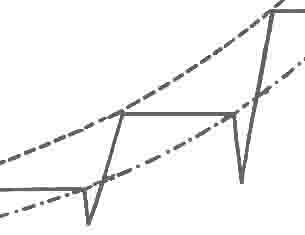 In a typical change diagram (right), the flat line of a stable state
(alpha) is followed by a tipping point of dissonance (beta) where the
gap between existential problems and the thinking exceeds a critical
depth, then a dip into a regressive search through previous, generally
inadequate solutions, to an inflection point (gamma) where barriers are
clear and stress initially high. When the release from gamma occurs,
there may be a rise with insight and new solutions to another inflection
point (delta), and then on to a new stable, homeostatic state. There may
also be stabilization at the previous level.
In a typical change diagram (right), the flat line of a stable state
(alpha) is followed by a tipping point of dissonance (beta) where the
gap between existential problems and the thinking exceeds a critical
depth, then a dip into a regressive search through previous, generally
inadequate solutions, to an inflection point (gamma) where barriers are
clear and stress initially high. When the release from gamma occurs,
there may be a rise with insight and new solutions to another inflection
point (delta), and then on to a new stable, homeostatic state. There may
also be stabilization at the previous level.
The two curves in this diagram represent (top, dashed) the accumulation
of existential problems and (bottom, dash dot) the activation of
appropriate neuropsychological potential to address them. The beta point
is reached when the problems so far outstrip the solutions that new
thinking is required for the system to keep going. It has the option of
regression or progression, the more common outcome. However, the process
is without guarantees.
Are
you Spiral Wizards?
 . .
.
We're not fans
of the 'Spiral Wizard' notion even though it is prominent in the 1996 SD
book, having found that most people who lay
claim to the title fall a wee bit short on grasping the intent of the theory or
applying it ecologically. There's enough hypocrisy in the world without
our adding more, so we make no claims to being psychologists, nor to
wizardry, only students of human nature.
It's a far cry from cognitively understanding
parts of a model to being the embodiment of what it represents. And
placing expectations for behaving in the ways one advocates for others
can be disappointing or worse. Describing is far simpler than being, and conflating theories with
theorists is usually a bad mistake. When "do as I say, not as I
do" is so commonplace, it's more honest not to be too grand. So, even though the Spiral Wizard
business was included in the book, we prefer to leave the wizardry to Harry Potter and to suggest
that there's much to be learned about human nature. This work is just
another scratch at the surface, and one limb of a fast-growing tree.
Therefore, our
mascot is the Spiral Lizard, a relatively mild-mannered creature that
represents the merging of many colors, each contributing to the whole
organism and with no pretension to knowing what color it truly is, only continuing to search around the field.
..
.
Got
a question that's not here, yet?
Submit
questions to info@spiraldynamics.org
and we'll try to get an answer and post it in this space.
..
This
document is created and maintained as a service by NVC
Consulting (Chris Cowan and Natasha Todorovic, partners)
If
you were redirected to this page from another website, go to
http://www.spiraldynamics.org
for more, or click a navigation button (top).
©
copyright 2004-2005 NVCConsulting and Humergence, LLC. All
rights reserved. Contact NVCC for permissions.
Humergence®
is a registered trademark of Humergence, LLC and NVC Consulting.
Spiral Dynamics® is a registered trademark of the National Values
Center, Inc., (since 1999) and should be noted as such.
It
is therefore protected under US law and international treaty. Use without
permission of the owners is an infringement.
|


